When planning a construction project, one common question is: Which TMT bar size should be used for the building?
There is no single TMT bar diameter that is suitable for every part of a building. The required diameter is determined by the structural design and depends on factors such as the loads acting on the structure, span, member dimensions, reinforcement requirements, spacing, and detailing.
This is why the TMT bars used in a slab may differ from those specified for a beam, column, or foundation.
The important point is that TMT bar diameter should be selected based on structural requirements, not simply by choosing a larger bar or copying the reinforcement used in another building.
In this guide, we will look at the main factors that determine the required TMT bar diameter and what homeowners should know before reinforcement work begins.
TMT bar diameter refers to the nominal thickness of the reinforcement bar, usually expressed in millimetres.
Common TMT bar diameters include 8mm, 10mm, 12mm, 16mm, 20mm, 25mm and larger sizes.
The diameter affects the cross-sectional area of the steel. As the diameter increases, the amount of steel contained in an individual bar also increases.
However, a larger diameter does not automatically mean a better reinforcement solution.
Structural design considers the required amount of reinforcement together with bar diameter, number of bars, spacing, position, concrete cover, and other detailing requirements.
The loads that a building needs to carry are one of the fundamental considerations in structural design.
These can include:
The structural engineer evaluates these loads when designing individual structural members.
A member carrying a different design load may therefore require a different reinforcement arrangement.
However, load is not considered by itself. It is evaluated along with the member dimensions, span, support conditions, concrete properties, steel grade, and other design factors.
The distance between the supports of a beam or slab affects how the member behaves under load.
As the span changes, the bending behaviour and reinforcement requirements can also change.
This does not mean that a particular span automatically requires one specific TMT bar diameter. Instead, the span is one of the inputs used in the structural calculations to determine the required reinforcement.
This is why the reinforcement used in one house should not simply be copied for another house, even when both buildings appear similar.
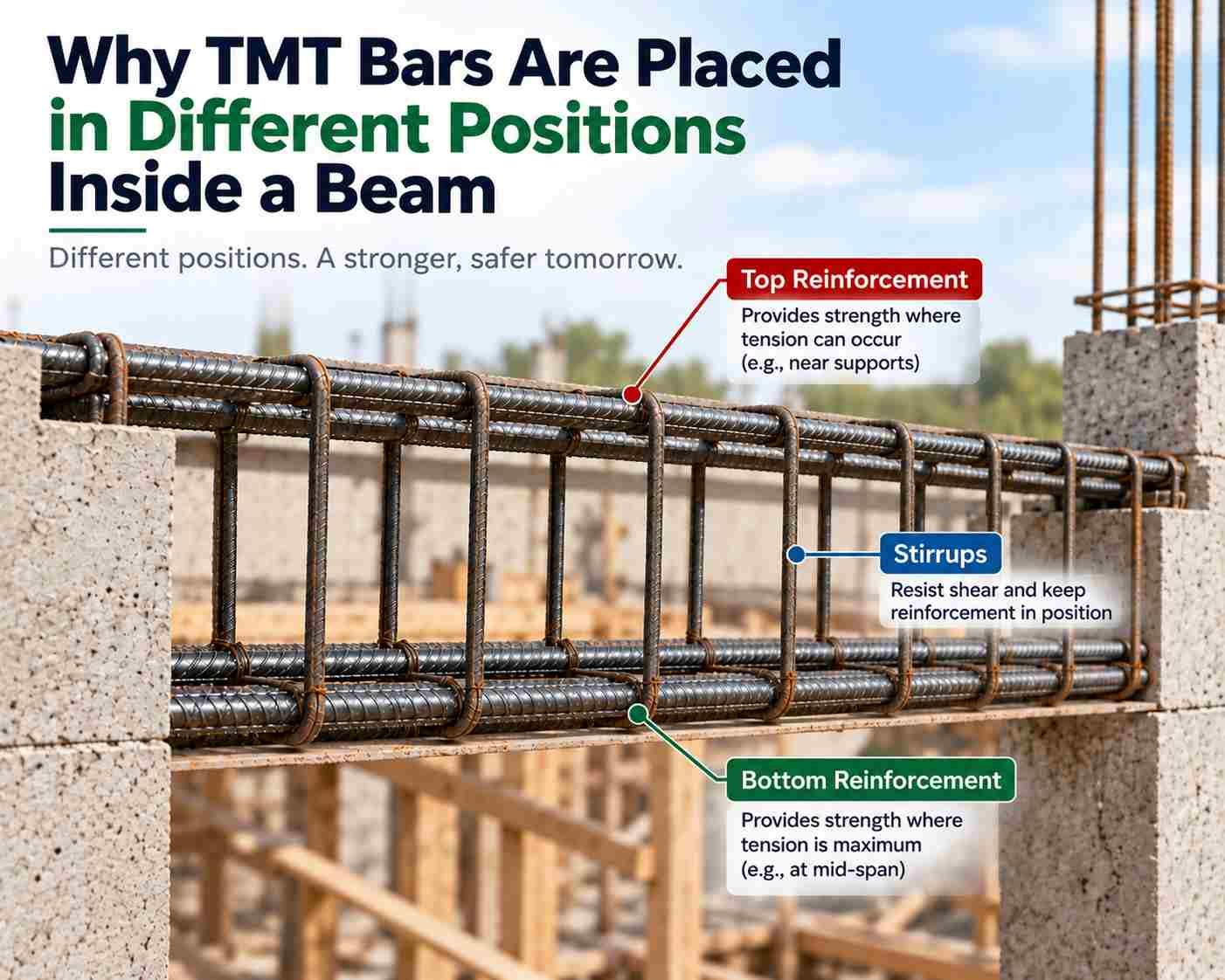
Also Read: Why TMT Bars Are Placed in Different Positions Inside a Beam
The dimensions of the structural member also influence reinforcement detailing.
For example, a beam or column has limited space within its concrete section. The reinforcement must fit within that space while maintaining the required cover and spacing.
The design therefore considers several dimensions together, including:
Changing the bar diameter can therefore affect the overall reinforcement arrangement.
The structural engineer first determines the reinforcement required for a particular member based on the structural design.
The required steel area may then be provided using an appropriate combination of:
This means that selecting the largest available TMT bar is not a substitute for structural design.
The objective is to provide the required reinforcement in the required arrangement.
Bar diameter should always be considered together with spacing.
Larger bars occupy more space within a concrete member. When several reinforcement bars are placed close together, there must still be adequate space for concrete to flow around the reinforcement and for proper compaction.
This is particularly important when reinforcement becomes congested.
Therefore, the engineer considers both the diameter and spacing of reinforcement when preparing the structural detailing.
Using fewer larger bars is not automatically equivalent to using more smaller bars. The appropriate arrangement depends on the structural design and detailing requirements.
Concrete cover is the specified distance between the outer surface of the concrete and the reinforcement.
It is an important part of reinforcement detailing and helps provide the required protection and durability for the reinforcement.
Bar diameter, cover, spacing, and member dimensions need to work together.
A change in bar diameter can therefore affect the available space inside a beam, column, slab, or other structural member.
Also Read: Why TMT Bars Need Proper Concrete Cover: A Simple Guide for Homeowners
A building contains different structural elements, and each performs a different function.
For example:
Because these members behave differently, their reinforcement requirements are not necessarily the same.
The structural engineer determines the appropriate reinforcement arrangement for each member based on its specific design requirements.
The way a structural member is supported can influence its behaviour under load.
For example, a simply supported beam and a continuous beam do not necessarily have the same reinforcement arrangement.
The location of tension and compression can vary depending on the structural system and loading conditions.
This is one reason reinforcement drawings may specify different bar arrangements at different locations within the same member.
TMT bar diameter and steel grade describe different properties.
Diameter refers to the physical size of the reinforcement bar, while grade refers to its specified mechanical properties.
For example, selecting a particular TMT grade does not by itself determine which diameter should be used.
The structural design specifies the required combination of steel grade, diameter, quantity, spacing, and detailing.
Therefore, both the grade and diameter should match the approved structural requirements.
Also Read: Why Your Contractor Recommends Specific TMT Bar Grades: The Reasoning Behind Every Grade Decision
No.
It may seem logical that a larger TMT bar would automatically make a structure stronger, but reinforced concrete design does not work that way.
Structural performance depends on the complete reinforcement arrangement, including:
A larger bar also occupies more space within the member and can affect spacing and reinforcement congestion.
Therefore, a specified TMT bar diameter should not be replaced with a larger diameter simply because it appears stronger.
A TMT bar diameter specified in a structural drawing should not be changed without approval from the structural engineer.
Changing the diameter can affect:
If a specified bar is unavailable or a change is required for any reason, the proposed alternative should be reviewed by the structural engineer before implementation.
The process generally follows these stages:
Step 1: Study the Building Design
The structural engineer reviews the architectural design and structural requirements of the building.
Step 2: Determine Design Loads
The applicable loads and design conditions are evaluated.
Step 3: Design the Structural Members
Beams, columns, slabs, foundations, and other structural elements are designed based on their individual requirements.
Step 4: Calculate the Required Reinforcement
The engineer determines the required reinforcement based on the structural calculations.
Step 5: Select Bar Diameter and Spacing
Suitable bar diameters, quantities, spacing, and reinforcement arrangements are selected to satisfy the design.
Step 6: Prepare Reinforcement Details
The reinforcement requirements are communicated through structural drawings and, where applicable, a Bar Bending Schedule.
A BBS provides details such as bar diameter, quantity, cutting length, bending shape, and weight for reinforcement fabrication and placement.
Homeowners do not need to calculate the required TMT bar diameter themselves.
Instead, they can make sure that the reinforcement being installed follows the approved structural design.
Before concreting, it is useful to confirm with the contractor or structural engineer that:
The goal is not to independently redesign the reinforcement, but to ensure that the approved design is properly executed on site.
Bar diameter also affects the theoretical weight of TMT reinforcement.
The commonly used formula is:
Weight per metre = D² ÷ 162
where D is the nominal bar diameter in millimetres.
As the diameter increases, the weight per metre increases as well.
This information is useful when estimating material quantities and checking steel requirements.
However, a weight chart should be used for weight and quantity calculations, not for independently deciding which diameter a structural member requires.
Also Read: TMT Steel Bar Weight Chart: 8mm, 10mm, 12mm & 16mm Explained
The right TMT bar diameter is not determined simply by choosing the largest bar or by looking at what was used in another building.
It is determined as part of the structural design, taking into account factors such as loads, span, member dimensions, required reinforcement, spacing, concrete cover, support conditions, steel grade, and detailing requirements.
For homeowners and contractors, the safest approach is simple: follow the approved structural drawing and consult the structural engineer before making any change to the specified TMT bar diameter.
Once the required diameter and reinforcement arrangement have been finalized, TMT bar weight charts and the Bar Bending Schedule can be used to plan quantities, fabrication, and material procurement accurately.