Every kilogram of steel wasted on a construction site was a calculation that went wrong before the first cut was made.
A Bar Bending Schedule is not administrative paperwork. It is the bridge between a structural engineer’s drawing and the steel yard on site. It converts abstract dimensions in a drawing into actual cutting instructions for each bar — diameter, length, bend angle, quantity, and weight. Done correctly, it eliminates guesswork at every stage: procurement, fabrication, placement, and verification.
A Bar Bending Schedule will tell you how each bar should be cut, bent, and placed according to the design and structural requirements. For TMT bars specifically, this precision matters more than most buyers and contractors realise, because the quality of the bar determines whether the BBS holds through execution.
This blog explains exactly how BBS works, from the columns in the document to the formulas behind the calculations. By the end, engineers and contractors will understand BBS not as documentation but as the control system that keeps a project on budget and on spec.
A Bar Bending Schedule is a comprehensive list that describes the location, mark, type, size, length, number and bending details of each reinforcement bar in a structure. It provides member identification, bar mark, shape of bending, diameter, length, total number and weight of bars.
In practice, every BBS document contains these standard columns:
| Column | What It Contains |
| Member | Which structural element — slab, beam, column, footing |
| Bar Mark | A reference code unique to each bar type (B1, T1, S1, etc.) |
| Shape Code | Bending shape as per IS 2502 — straight, L-shape, U-shape, stirrup, cranked |
| Diameter (mm) | Bar diameter — 8mm, 10mm, 12mm, 16mm, 20mm, 25mm, 32mm |
| Cutting Length | Actual length to cut — includes straight length + hooks − bend deductions |
| No. of Bars | Quantity per member |
| No. of Members | How many identical members exist in the structure |
| Total No. of Bars | No. of Bars × No. of Members |
| Total Length (m) | Cutting length × Total no. of bars |
| Weight (kg) | Total length × D²/162 |
The BBS is used by the detailer, the person checking the drawing, the contractor ordering reinforcement, the fabricating organisation, the steel fixer, the clerk of works, and the quantity surveyor. Every person in that chain reads the same document, which is why precision and standardisation matter.
Steel bar weight formula
W = D² ÷ 162 (kg per metre)
Where D = diameter of bar in mm. Derived from volume × steel density (7,850 kg/m³).
Quick reference for the most common bar sizes:
| Diameter | D²/162 | Weight per Metre | Weight per 12m Bar |
| 8mm | 64 ÷ 162 | 0.395 kg/m | 4.74 kg |
| 10mm | 100 ÷ 162 | 0.617 kg/m | 7.40 kg |
| 12mm | 144 ÷ 162 | 0.889 kg/m | 10.67 kg |
| 16mm | 256 ÷ 162 | 1.580 kg/m | 18.96 kg |
| 20mm | 400 ÷ 162 | 2.469 kg/m | 29.63 kg |
| 25mm | 625 ÷ 162 | 3.858 kg/m | 46.30 kg |
| 32mm | 1024 ÷ 162 | 6.321 kg/m | 75.85 kg |
Cutting length general formula
Cutting Length = Clear Span − (2 × Cover) + (2 × Hook Length) − (Bend Deductions)
Specific hook and bend values are governed by IS 2502:1963.
The primary IS code used for Bar Bending Schedule preparation is IS 2502:1963, which defines standard practices for bending and fixing reinforcement bars in RCC work. It covers hook length, bend allowance, cutting length, bar shapes, and reinforcement detailing.
Hook allowance is taken as 9d for standard 90° hooks (k value = 2). So for a 10mm stirrup bar: hook length = 9 × 10 = 90mm per hook. For a 16mm main bar: hook length = 9 × 16 = 144mm per hook. Minimum hook length is 75mm regardless of calculation.
| Bend Angle | Deduction per Bend | Example: 12mm bar |
| 45° | 1d | 1 × 12 = 12mm |
| 90° | 2d | 2 × 12 = 24mm |
| 135° | 3d | 3 × 12 = 36mm |
Minimum lap length for Fe 500 and Fe 550 SD bars: 40d to 50d depending on element and stress condition.
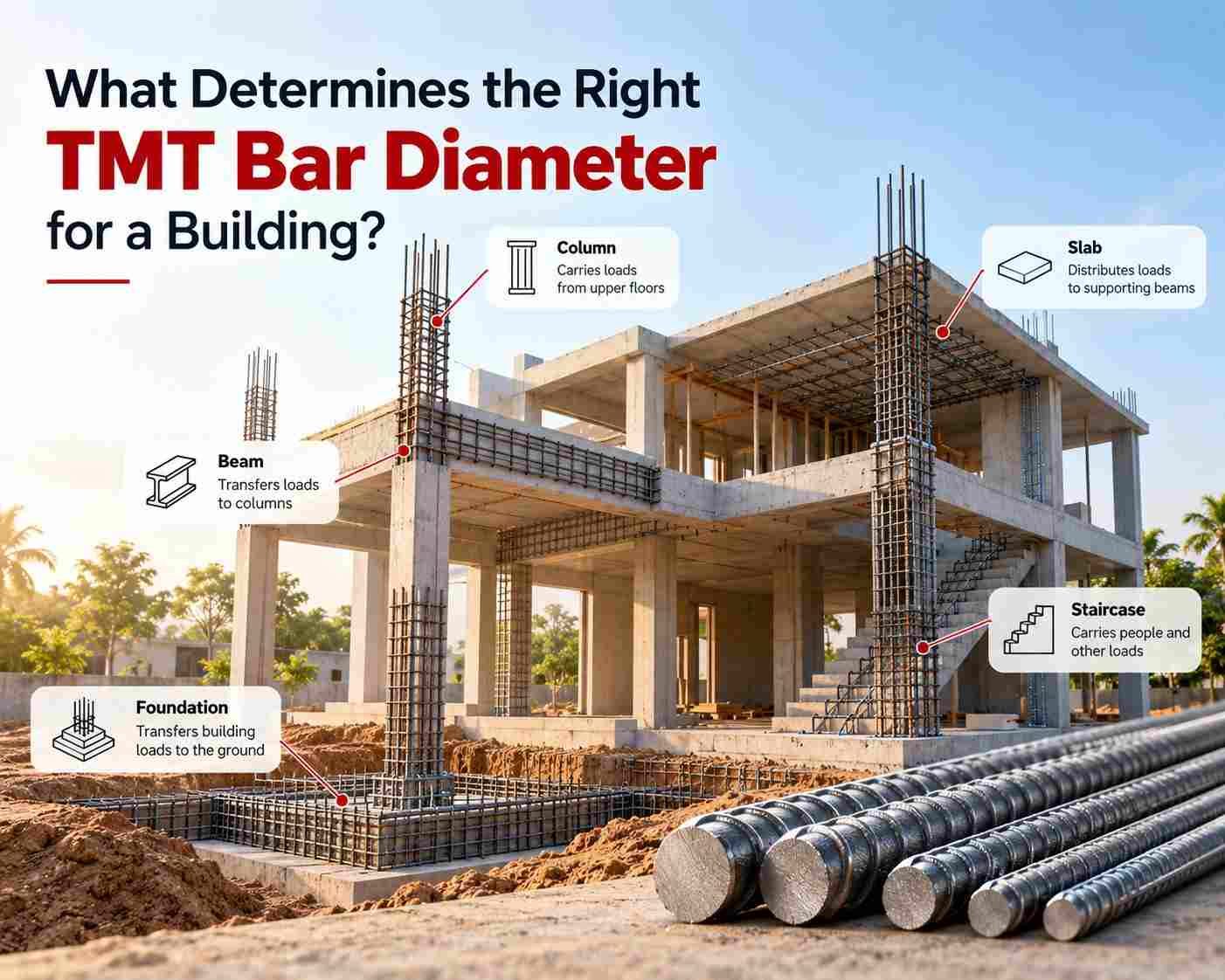
Two families of bars: main reinforcement (spanning direction) and distribution bars (perpendicular). Both are typically straight bars with standard hooks. Cranked bars (bent up at one-third the span) are used at supports where the bending moment reverses. Cover: 20mm standard in slabs.
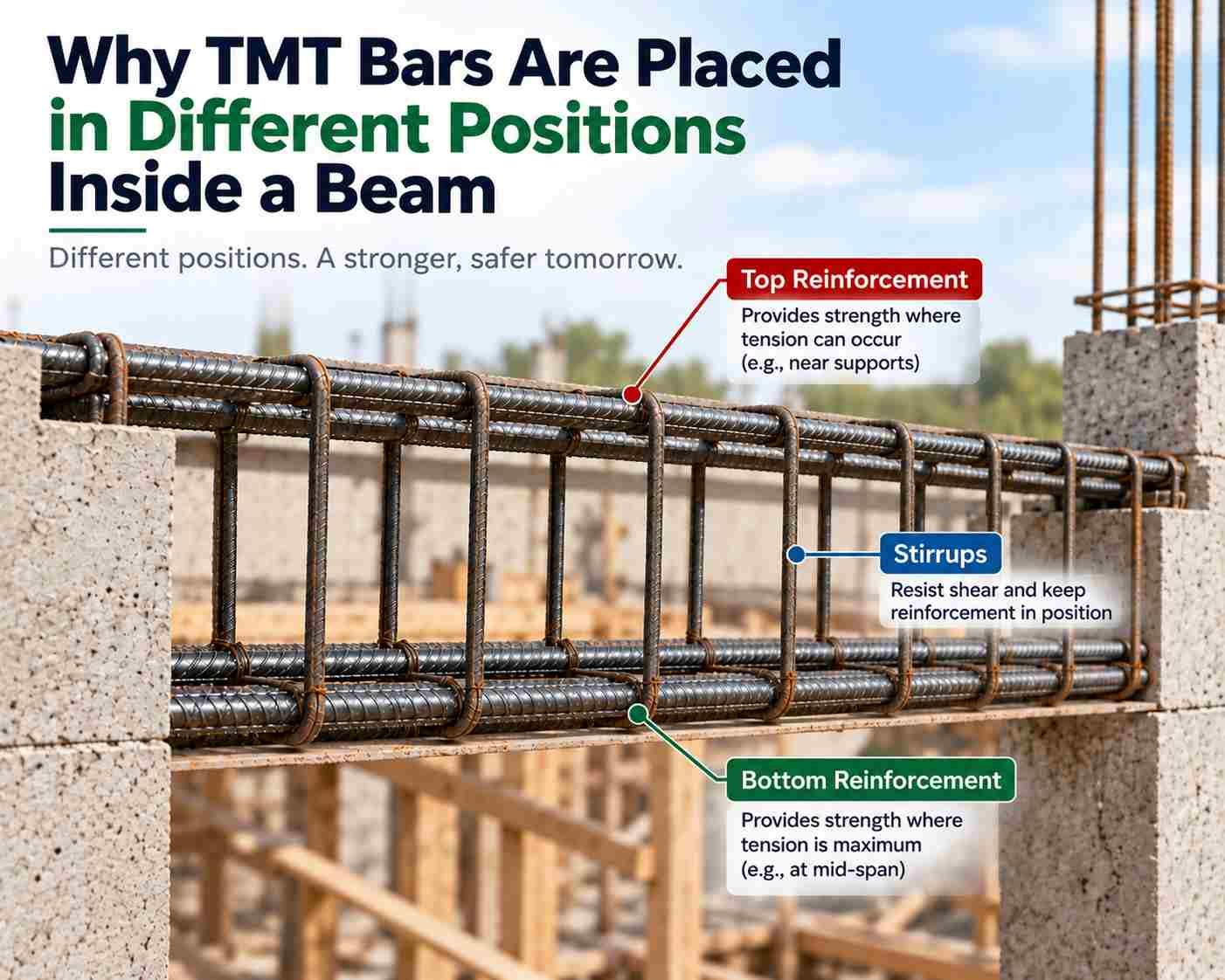
Three families: top bars (hogging at supports), bottom bars (sagging at midspan), and stirrups (shear resistance along the full length). Stirrups are the most calculation-intensive bars in any BBS. Each requires a precise cutting length accounting for cross-section dimensions, cover, hook lengths, and bend deductions. Cover: 40mm for moderate exposure.
Two families: main longitudinal bars and lateral ties or spirals. The main bars include lap lengths at every storey, bars cannot run continuous through the full building height. Tie spacing must match the design drawing exactly — ties are more closely spaced near joints in seismic design. Cover: 40mm.
Two directions of bottom bars in a mat or isolated footing. Bars typically run continuous without bends. Cover is higher — 50 to 75mm in direct contact with the ground. The footing BBS also calculates column starter bars (dowels) that project upward into the column above, these must match the column’s main bar size and include the specified anchorage length.
This is the connection that most BBS guides never make and it is the most practically important one.
A BBS is built on two assumed constants: the diameter of each bar and its weight per metre. Both are calculated using the nominal size. A 16mm bar is assumed to weigh 1.580 kg/m throughout the BBS.
If a 16mm bar from a substandard manufacturer actually measures 15.6mm consistently, two problems occur simultaneously:
Quality-controlled manufacturing keeps bars within IS tolerance, plus or minus 3% for sizes above 16mm, plus or minus 5% for 10mm to 16mm. Substandard manufacturing does not.
Kenza TMT produces every bar from 100% virgin steel billets using German rolling mill technology. Every batch is tested to confirm diameter, weight per metre, yield strength, and elongation before dispatch. The batch test certificate is accessible by scanning the barcode on each bundle, so both the engineer preparing the BBS and the contractor receiving the delivery are working from verified, consistent data.
When steel behaves exactly as the BBS assumes, schedules translate from paper to site without loss. When it does not, even a perfect BBS becomes an approximation.
Also Read : Understanding the Bar Bending Schedule
Steel is expensive. At Rs. 60 to Rs. 80 per kg for quality Fe 550 SD bars, a 1,000 sq ft home uses Rs. 2 to Rs. 3 lakhs worth of steel. A 10% wastage from poor BBS practice is Rs. 20,000 to Rs. 30,000 lost — without any structural benefit.
A properly prepared Bar Bending Schedule eliminates that waste. More importantly, it ensures that every bar is where the structural drawing says it should be the right diameter, the right length, the right shape, the right anchorage. This is what structural safety means in practice.
For Kenza TMT Fe 550 SD bars, the BBS is as reliable as the steel itself. Uniform diameter, consistent weight per metre batch to batch, and barcode-verified test certificates mean the two assumptions every BBS makes are confirmed values not estimates.