When your contractor says “we need Fe 550 SD for this project” — do you know why? Most homeowners do not. And that knowledge gap costs them either money or safety. At some point in every construction project, the question of TMT bar grades comes up.
Your structural engineer specifies a grade in the drawing. Your contractor mentions it when discussing material requirements and your dealer gives you a price for a specific grade. And for most homeowners and even many first-time contractors, the distinction between Fe 500, Fe 500D, Fe 550, Fe 550D, Fe 550 SD, and Fe 600 is genuinely unclear.
This is not a small gap. The grade of TMT bar used in your structure is the single most consequential material decision in your entire construction project. Choosing a lower grade than specified saves a few rupees per kg but undermines the structural design. Choosing a higher grade than needed adds cost without adding meaningful safety.
By the end of this guide, you will know:
Before understanding grade recommendations, understand the grade system itself.
Every TMT bar grade follows the same naming logic. Fe stands for Ferrum — the Latin name for iron, the primary element in steel. The number that follows — 415, 500, 550, 600 — is the minimum yield strength of the bar in N/mm² (Newtons per square millimetre, also called megapascals, MPa).
Yield strength is the load at which the bar begins to permanently deform. A Fe 500 bar will begin to deform at 500 N/mm². A Fe 550 bar will not begin to deform until 550 N/mm². This is the number that structural engineers use when calculating whether a bar of a given diameter can carry the load assigned to it in a specific structural element.
The suffix letters carry additional meaning:
D — stands for ductility. A Fe 500D bar has the same yield strength as Fe 500 but with enhanced elongation, meaning it can stretch further before fracturing. This matters in earthquake-prone zones where the bar needs to absorb seismic energy by deforming rather than snapping.
SD — stands for Special Ductility. This is a step above D — higher elongation percentage, tighter chemical composition controls, and in Kenza’s case, CRS (Corrosion Resistant Steel) certification. Fe 550 SD is Kenza’s flagship grade — the highest residential grade combining strength, ductility, and corrosion resistance.
Yield strength: 500 N/mm²
Key properties: Good balance of strength and flexibility. BIS certified under IS 1786. Adequate ductility for standard RCC construction.
Fe 500 is the minimum grade recommended for most residential construction in India today. It replaced the older Fe 415 standard as the baseline because it delivers meaningfully more strength per kg of steel, meaning you can achieve the same structural capacity with slightly less material, reducing overall project cost.
When your contractor recommends Fe 500:
What to ask if Fe 500 is recommended:
Is the project in a seismic zone? Is it within 10 km of the coast? If yes to either, ask whether Fe 500D or Fe 550 SD would be more appropriate. For Kerala specifically, most structural engineers have moved away from specifying plain Fe 500 as the default because of the state’s humidity, seismic activity, and coastal exposure.
Yield strength: 500 N/mm²
Key properties: Same strength as Fe 500 but with significantly higher elongation — the ability to stretch further before fracturing. Lower carbon, sulfur, and phosphorus content than Fe 500, giving better weldability.
The D in Fe 500D is the critical differentiator. Enhanced ductility means the bar can absorb the energy of an earthquake by deforming in a controlled way rather than fracturing suddenly. This is why Fe 500D bars are suitable for earthquake-prone areas and critical structures requiring superior ductility and strength.
In structural terms, ductility is what keeps a building standing during an earthquake — not just strength. A strong but brittle bar fractures under seismic load. A ductile bar bends, absorbs the shock, and maintains structural continuity.
When your contractor recommends Fe 500D:
The contractor’s reasoning: In Kerala’s seismic context, most responsible structural engineers specify Fe 500D as the minimum for multi-storey residential construction. The price difference over Fe 500 is marginal. The ductility benefit in a seismic event is significant.
Yield strength: 550 N/mm²
Key properties: Higher yield and tensile strength than Fe 500 series. Excellent resistance to seismic forces and structural stability. Preferred for heavy-duty construction projects.
Fe 550 delivers meaningfully more load-carrying capacity per bar than Fe 500. In large-span structures, high-rise buildings, or infrastructure where the structural engineer calculates that Fe 500D does not provide adequate strength with the specified bar sizes, Fe 550 is the specification upgrade.
When your contractor recommends Fe 550:
The contractor’s reasoning: The structural engineer’s load calculation shows that a Fe 500 bar of the specified diameter has insufficient strength margin for the loads assigned. Rather than increase bar diameter — which adds material cost and creates congestion issues specifying Fe 550 achieves the required capacity with the same bar sizes already in the drawing.
Yield strength: 550 N/mm²
Key properties: The strength of Fe 550 combined with the ductility benefits of the D designation. Higher elongation than Fe 550. Improved chemical composition for better weldability. Excellent choice for projects combining high load and high seismic risk.
Fe 550D occupies the space between the strength of Fe 550 and the ductility of the D series. Used in heavy-duty constructions like industrial buildings, bridges, dams, and structures subjected to extreme loading conditions and environmental factors.
When your contractor recommends Fe 550D:
The contractor’s reasoning: The project has both a high structural load requirement (pointing toward Fe 550) and a seismic or dynamic loading condition (pointing toward a D-grade ductility requirement). Fe 550D satisfies both without requiring a move to the highest and most expensive grade.
Yield strength: 550 N/mm²
Key properties: Special Ductility (elongation minimum 16%), CRS (Corrosion Resistant Steel) certification, manufactured from 100% virgin steel billets using German rolling mill technology. BIS certified under IS 1786.
Fe 550 SD is Kenza’s highest residential grade and the most technically complete answer to Kerala’s specific construction demands. The SD designation goes beyond the standard D specification — it combines higher strength, superior ductility, and CRS certification in a single product.
Understanding why Fe 550 SD was developed requires understanding what Kerala’s construction environment actually demands:
Seismic demand: Kerala spans Seismic Zones II and III. Special Ductility (SD grade) means the bar has higher elongation capacity — it can absorb more seismic energy through deformation before fracturing. This is the most critical safety property for structures in earthquake-prone districts.
Coastal and humidity demand: Kerala has a 590 km coastline and average humidity of 75 to 85% even inland. CRS certification means the steel’s chemical composition has been engineered to resist chloride-induced corrosion — the most common cause of premature structural failure in coastal and humid environments.
Strength demand: At 550 N/mm² yield strength, Fe 550 SD provides more structural capacity per bar than the 500-series grades — allowing structural engineers to achieve required load capacities with the same or smaller bar diameters, reducing material cost.
The contractor’s reasoning: For most Kerala residential and commercial construction, Fe 550 SD is the grade that most comprehensively addresses the combined seismic, coastal, and humidity challenges the structure will face over its 50 to 70-year design life. The price difference over Fe 500D is a few rupees per kg. The combined benefits — higher strength, Special Ductility, and CRS protection — justify the specification for any project that will be standing in Kerala’s environment for decades.
Also Read : Best TMT Steel in Kerala for Home Construction: Why Fe 550 SD is the Right Choice
Key properties: Exceptional strength and durability. Designed for specialised applications requiring ultra-high performance. More limited ductility than lower grades — the trade-off for maximum strength.
Fe 600 represents the highest strength grade in standard TMT bar production. It is not a general-purpose residential grade, it is specified for structures that have unusually high concentrated load requirements that cannot be satisfied by Fe 550-series bars at any practical bar diameter.
The contractor’s reasoning: The structural calculation shows that the load on a specific element — typically a heavily loaded column or a transfer beam carrying multiple floors, cannot be handled by Fe 550 SD at any bar diameter that fits within the concrete cross-section. Fe 600 is the engineering solution.
Important note: Fe 600 should only be specified when the structural engineer’s calculations specifically require it. It is not a “better is always better” upgrade — the lower ductility of Fe 600 means it is not suitable as a general replacement for Fe 550 SD in seismic zones without specific engineering justification.
Now that you understand each grade, understand the framework your contractor and structural engineer use to arrive at a recommendation.
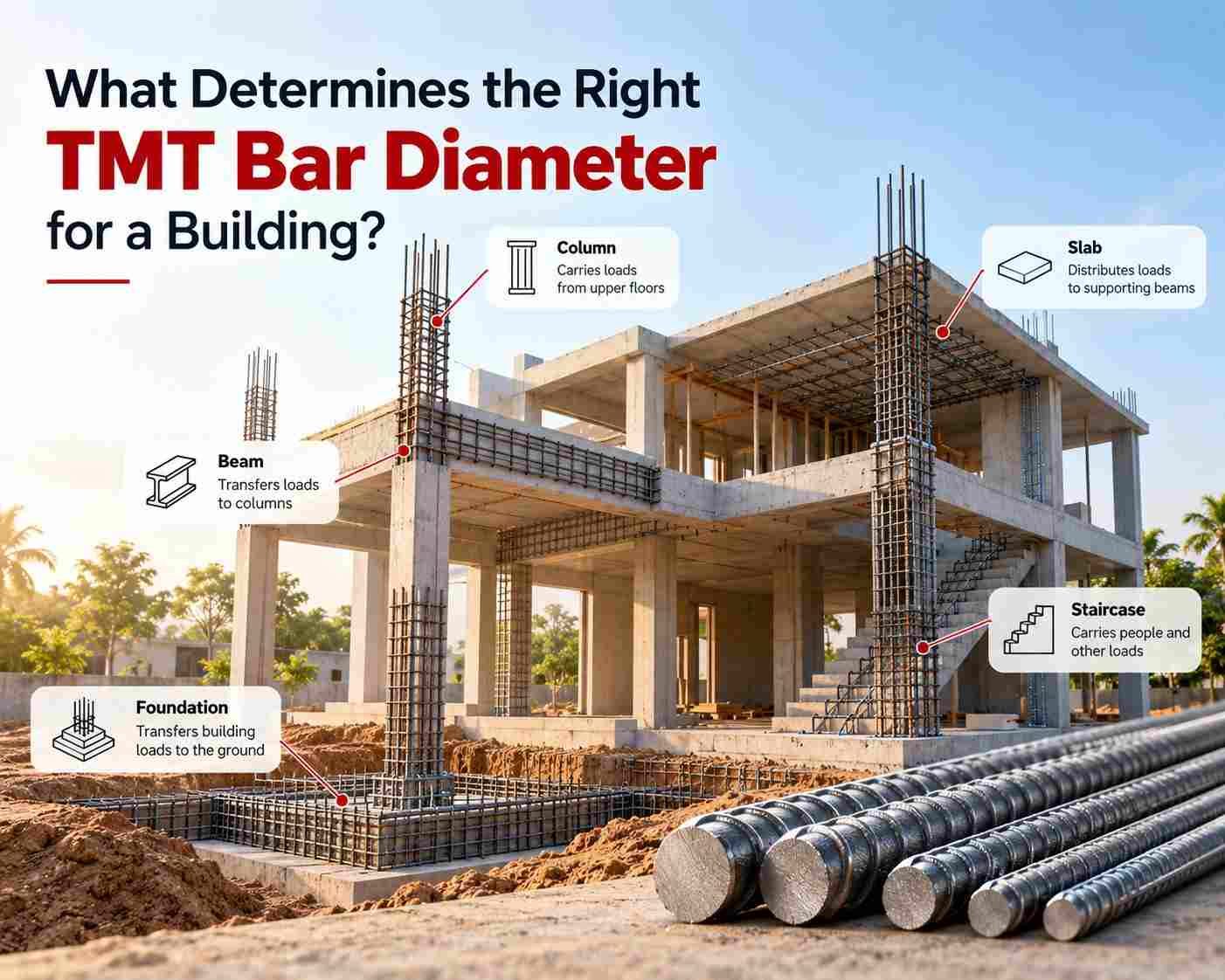
Different elements in the same building can legitimately use different grades. A ground-floor column carrying eight floors above it may require Fe 550 SD. A partition wall lintel in the same building may be adequately served by Fe 500D. The grade is specified element by element in the structural drawing — not as a single decision for the whole building.
IS 1893 classifies India into four seismic zones (II through V). Kerala spans Zones II and III. For structures in these zones, ductility is a primary structural safety requirement not a secondary consideration. This pushes grade recommendations toward D-series and SD grades regardless of other factors.
IS 456 classifies exposure conditions from mild to very severe. Coastal Kerala, high-humidity areas, and structures near chemical or industrial environments fall into severe or very severe categories. For these conditions, CRS-certified bars like Kenza Fe 550 SD are specified to extend the structure’s effective service life.
The grade recommendation also reflects a whole-project cost calculation. Fe 550 SD’s higher yield strength means fewer or smaller bars can achieve the same structural capacity as a larger number of Fe 500 bars. When the structural engineer runs the numbers, the material cost difference between grades is often smaller than buyers expect and sometimes the higher grade actually reduces total steel consumption enough to offset the per-kg price difference.
| Grade | Yield Strength | Ductility | Best Application in Kerala |
| Fe 500 | 500 N/mm² | Standard | Basic G+1 homes, low-risk inland zones |
| Fe 500D | 500 N/mm² | Enhanced | Residential in seismic zones, multi-storey |
| Fe 550 | 550 N/mm² | Standard | Commercial buildings, heavy load structures |
| Fe 550D | 550 N/mm² | Enhanced | High-rise + seismic + heavy load projects |
| Fe 550 SD | 550 N/mm² | Special (16%+) | Most Kerala homes — coastal, humid, seismic |
| Fe 600 | 600 N/mm² | Limited | Specialised heavy industrial and infrastructure |
Also Read : Why Choosing the Right Grade of TMT Bar Matters in Different Construction Projects.
Your structural engineer’s drawing specifies the grade. Your contractor’s material order should match this specification exactly. If your contractor orders Fe 500 when the drawing specifies Fe 500D or orders Fe 500D when Fe 550 SD was specified, this is a deviation from the structural design that needs to be corrected before concreting.
Every batch of TMT bars delivered to your site should come with a mill test certificate confirming the grade, yield strength, elongation percentage, and chemical composition. Ask for it. With Kenza TMT bars, scan the barcode on the dispatch bundle to access the batch-specific certificate instantly — confirming the grade you ordered is the grade that arrived.
A contractor who suggests substituting Fe 500 for Fe 500D “because it is cheaper and the same strength” is making a decision that affects your building’s seismic performance. Any grade substitution from what the structural drawing specifies requires written approval from the structural engineer — not the contractor’s verbal reassurance.
When your contractor recommends a specific TMT bar grade, they are not making a suggestion. They are implementing a structural engineer’s calculated decision about what your building needs to be safe for its entire design life.
Understanding that decision, what each grade offers, what factors drive the recommendation, and how to verify it was implemented correctly is part of responsible construction ownership. It takes five minutes to understand. It protects a building that will stand for 50 years.
Kenza TMT manufactures all six grades — Fe 500, Fe 500D, Fe 550, Fe 550D, Fe 550 SD, and Fe 600 from 100% virgin steel billets using German rolling mill technology. Every batch is tested and barcode-tagged for complete quality traceability. Whatever grade your structural engineer specifies, Kenza supplies it with the consistency that makes your contractor’s recommendation a promise not just a specification.
Know your grade. Verify your delivery. Build with confidence.