A TMT bar does not transfer its full force to concrete simply because it is placed inside a structural member. The reinforcement needs sufficient embedment so that the required stress can be transferred between the steel and surrounding concrete.
This is the purpose of development length.
Development length is the length of reinforcement required to develop the necessary stress in a bar through the bond between the reinforcement and concrete. It is an important part of reinforcement detailing in RCC construction and is covered under the reinforcement provisions of IS 456:2000.
For homeowners and contractors, understanding development length helps explain why reinforcement bars may extend beyond a particular section, continue into a supporting member, or require specific anchorage details instead of simply stopping at the end of a beam or slab.
Development length, represented as Ld, is the length of a reinforcement bar that needs to be embedded in concrete so that the bar can develop the required stress through bond.
In simple terms, the steel and concrete need enough interaction for the force in the reinforcement to be transferred safely into the surrounding concrete.
IS 456:2000 states that the calculated tension or compression in a reinforcement bar at a section should be developed through an appropriate development length, end anchorage, or a combination of both.
This is why reinforcement bars are often extended into supports or adjoining structural members rather than being terminated exactly at a particular point.
Reinforced concrete works through the interaction between concrete and steel.
When a structural member is subjected to load, the reinforcement needs to develop the stress assumed in the structural design. The force in the reinforcement is transferred to the surrounding concrete through the bond between the two materials.
If the reinforcement does not have sufficient development or anchorage, the bar may not be able to develop the required stress assumed by the design.
Development length therefore helps ensure that the reinforcement and concrete can work together as intended.
TMT bars have a ribbed surface that provides mechanical interaction with the surrounding concrete.
As forces are transferred between the reinforcement and concrete, the ribs help develop resistance along the embedded portion of the bar.
The required development length is not based only on the physical length of the bar. It depends on factors such as the bar diameter, stress in the reinforcement and design bond stress.
This is why development length needs to be determined as part of the structural design rather than estimated by simply looking at the bar.
IS 456:2000 gives the following expression for development length:
Ld = (φ × σs) / (4 × τbd)
Where:
The formula shows that development length depends on more than just the diameter of the TMT bar. The stress in the reinforcement and the design bond stress are also part of the calculation.
The applicable code provisions and project-specific structural design should therefore be followed instead of applying one fixed length to every situation.
Bar diameter is directly included in the development-length calculation.
A change in diameter can therefore change the development requirement.
This is one reason why the TMT bar diameter specified in the structural drawing should not be changed at the construction site without review by the structural engineer.
The stress that needs to be developed in the reinforcement also affects the required development length.
The structural engineer determines the forces acting on the member and the corresponding reinforcement requirements. The development and anchorage details are then designed accordingly.
The concrete surrounding the bar contributes to the bond between the reinforcement and concrete.
IS 456 specifies design bond stress values and provides provisions for deformed reinforcement. The relevant bond-stress provisions depend on the concrete and reinforcement conditions.
This means that development length cannot be selected independently of the concrete and reinforcement specified for the project.
The reinforcement may be required to develop stress in tension or compression.
The applicable detailing provisions can differ depending on the condition of the reinforcement. Development length should therefore be considered in the context of the actual structural design rather than using the same assumed value everywhere.
Development length and anchorage are closely related concepts.
Development length refers to the required embedded length that allows a reinforcement bar to develop its required stress through bond.
Anchorage refers more broadly to the arrangement used to transfer the force from the reinforcement into the surrounding concrete.
IS 456 recognises development length, end anchorage, or a combination of the two as ways of developing the calculated tension or compression in reinforcement.
Depending on the structural detailing, anchorage can involve straight embedment as well as permitted bends or hooks.
Development length and lap length are often confused, but they serve different purposes.
Development length allows a reinforcement bar to develop its required stress through bond with concrete.
Lap length is used when two reinforcement bars overlap so that force can be transferred from one bar to the other.
For example, if a continuous reinforcement bar cannot be provided for the required length, two bars may be overlapped according to the structural detailing.
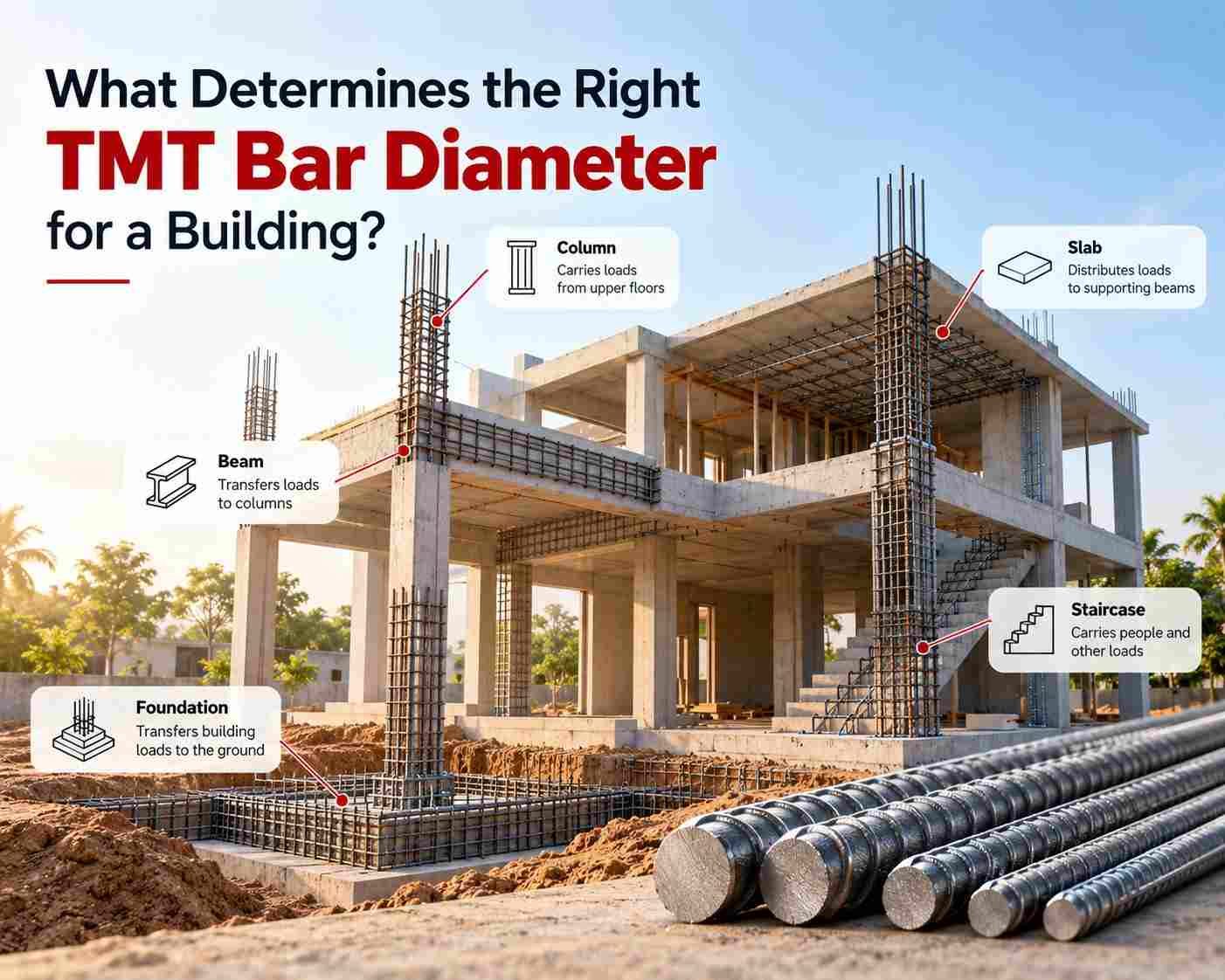
Development length is relevant wherever reinforcement needs to transfer its design force into concrete.
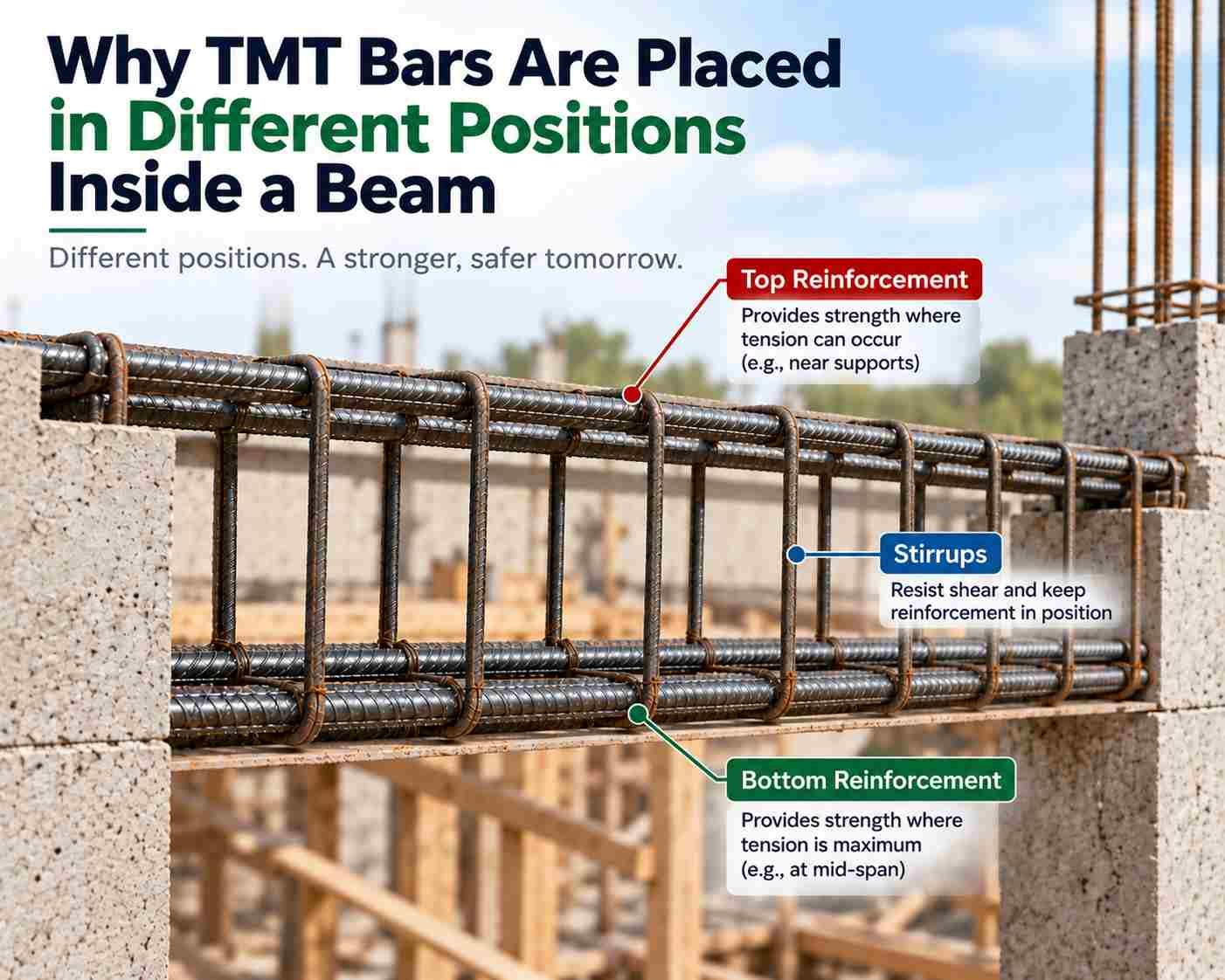
Reinforcement in beams may need to extend into supporting regions so that the required forces can be developed.
The exact arrangement depends on the structural design, support conditions and reinforcement detailing.
This is different from simply deciding where top or bottom reinforcement should be positioned inside a beam.
At a beam-column connection, reinforcement from one structural member may need to continue into or through another member according to the structural design.
Proper anchorage and development are important because the connection must transfer the forces assumed in the structural design.
The exact detailing should follow the structural drawings and applicable design provisions.
Slab reinforcement also needs to be properly developed at supports and other locations specified by the structural design.
The purpose here is not to explain slab design itself, but to understand why reinforcement cannot simply be stopped at an arbitrary location.
Foundation reinforcement also requires appropriate development and anchorage according to the structural design.
Starter bars, column reinforcement and footing reinforcement may need to extend to specified lengths so that the required forces can be transferred.
The exact dimensions and detailing should come from the structural drawings.
A common assumption on construction sites is that a reinforcement bar can stop once it has passed the portion of the structure where it appears to be needed.
But reinforcement needs sufficient length to develop its required force.
The point where a bar appears to stop carrying load is therefore not necessarily the point where the reinforcement can be terminated.
This is why reinforcement drawings specify bar lengths, extensions and anchorage details.
Bar diameter appears directly in the development-length formula, so changing the diameter can affect the calculated development length.
However, it would be incorrect to say that every larger TMT bar simply requires a fixed multiple of its diameter in every situation.
The actual requirement depends on the structural design and applicable code provisions.
This is another reason why replacing a specified bar with a different diameter should be reviewed by the structural engineer.
If a reinforcement bar does not have sufficient development or anchorage, it may not be able to develop the stress assumed in the structural design.
This can affect the intended transfer of forces between the reinforcement and concrete.
The exact consequence depends on the structural member, loading, reinforcement arrangement and extent of the detailing deficiency. It should therefore not be assumed that every inadequate anchorage situation will produce the same type of failure.
If a bar appears shorter than specified in the structural drawing, the issue should be referred to the structural engineer before concreting.
Hooks and bends can contribute to anchorage where they are permitted by the applicable design and detailing provisions.
However, they should not be added or modified simply as a site-level solution when a reinforcement bar appears too short.
The size, shape, location and detailing of bends or hooks should follow the approved reinforcement details.
This is also where a Bar Bending Schedule becomes useful.
Development length should not be shortened or modified without approval from the structural engineer.
Site conditions can sometimes create practical difficulties. A bar may appear too long for the available space, a connection may differ from the drawing, or a contractor may want to change the reinforcement arrangement.
These situations should be resolved through the structural design team rather than by cutting or bending the bar differently on site.
A small change in reinforcement detailing can affect the way forces are transferred through the structure.
Construction sites sometimes use simple rules based on multiples of the bar diameter, such as 40 or 50 times the bar diameter.
However, these should not be treated as universal development-length values for every situation.
The IS 456 development-length equation considers factors including bar diameter, stress in the bar, and design bond stress. The applicable reinforcement and detailing conditions also need to be considered.
So, instead of applying a fixed “40d” or “50d” rule, the required development length should follow the structural design and applicable code provisions.
A good TMT bar alone does not determine whether reinforcement has been correctly installed.
The reinforcement needs to match the structural design, including:
These elements work together as part of the reinforcement detailing.
Development length is the required embedded length that allows a TMT bar to develop the stress specified by the structural design through its bond with concrete.
It depends on factors including bar diameter, stress in the reinforcement and design bond stress, rather than being a universal fixed length for every structural situation. IS 456:2000 provides the relevant provisions for development of stress, development length and anchorage.
For homeowners and contractors, the practical takeaway is simple: do not shorten, relocate or modify reinforcement based on assumptions at the construction site. Follow the approved structural drawing and consult the structural engineer if a change is required.
Proper development and anchorage allow TMT reinforcement to transfer forces effectively to the surrounding concrete and perform the role intended by the structural design.