A delay during concrete pouring can create a problem that remains hidden inside a structure. When fresh concrete is placed against concrete that has already started setting, cold joints in concrete may form, potentially affecting the bond between the two layers.
Delayed concrete deliveries, equipment breakdowns and unexpected rain can interrupt concrete placement on construction sites. These interruptions require careful handling to maintain the quality and integrity of the concrete.
In this article, we explore why cold joints form, how they differ from planned construction joints, the risks they can create, and the practical steps contractors and site supervisors can take to prevent and manage them.
A cold joint is an interface or discontinuity that forms when fresh concrete is placed against concrete that has already started setting, preventing the two placements from properly integrating.
Concrete is normally placed and compacted in a planned sequence so that successive portions can form a continuous mass. When an interruption occurs at the wrong stage, the earlier concrete may lose the workability needed for effective integration with the new batch.
The resulting interface may become a potential plane of weakness. Its significance depends on where it forms, how well the concrete has bonded, and what structural or durability demands the location must withstand.
A cold joint is not necessarily a visible crack or an open gap. It can appear as a line or seam in the finished surface, while the interface inside the concrete may be difficult to assess visually.
For this reason, a site team should not judge a suspected cold joint only by its appearance. Its location and the circumstances in which it formed matter just as much.
These terms are related, but they do not mean the same thing.
A construction joint is an interface intentionally provided between successive concrete placements to suit the construction sequence. Its location and detailing should be planned appropriately for the structural element.
A cold joint, by contrast, describes an interface or discontinuity that develops because a delay prevents successive concrete placements from integrating as intended.
For example, a contractor may plan a concrete pour in stages and provide an approved construction joint at the specified location. That is different from an unplanned interruption that leaves the earlier concrete too far into the setting process for the next placement to bond properly.
| Construction joint | Cold joint |
| Planned as part of the construction sequence | May develop because of an unplanned delay |
| Location and preparation can be specified in advance | Location may be determined by where the interruption occurs |
| Detailing and surface preparation are planned | Assessment and corrective action may be necessary |
| Can be designed to transfer the required forces | May create a weakness if the interface does not perform as required |
The distinction matters because a joint is not automatically a defect simply because concrete was placed in separate stages. What matters is whether the interface was properly planned, prepared and executed for its intended function.
Cold joints usually develop when concrete placement is interrupted long enough for the earlier concrete to begin setting and lose the ability to integrate properly with the next batch.
Several site conditions can contribute to this.
When ready-mixed concrete is delivered in multiple loads, the timing between deliveries matters. A delayed vehicle can leave the site team waiting while concrete already placed in the formwork continues to change.
Traffic congestion, dispatch problems, access restrictions and poor coordination between the batching plant and site can all interrupt the intended sequence.
For sites in Kerala, where narrow access roads or busy local routes may affect delivery schedules, arranging the delivery sequence in advance can help reduce avoidable interruptions.
A pump breakdown, blocked delivery line or failure of essential equipment can stop placement even when concrete is available.
The risk becomes greater when the interruption affects a critical part of a continuous pour. A replacement pump or a quick repair may help, but the team must first assess the condition of the concrete already placed.
Resuming work simply because the equipment is running again does not establish that the earlier and fresh concrete will bond properly.
A concrete pour requires more coordination than arranging cement, aggregates and labour. The team must consider the volume of concrete, placement rate, available equipment, manpower, access and the sequence in which different sections will be filled.
If the planned pour is larger than the site’s practical capacity, work may stop before the intended section is completed.
Before a major slab, beam or column pour, the contractor should identify likely interruption points and agree on an appropriate contingency plan with the responsible engineer.
Concrete does not remain workable for a fixed period under every condition. Temperature, cement characteristics, mix proportions and admixtures can influence setting behaviour.
Consequently, a delay that may be manageable under one set of conditions could create a problem under another. There is no single time limit that guarantees a cold joint will or will not form on every project.
The actual condition of the concrete and the requirements of the approved mix and placement procedure must guide the decision.
Rain can interfere with concrete placement, access, visibility and site operations. A sudden downpour may force the team to stop while the earlier concrete is already in place.
Rain itself does not automatically create a cold joint. The risk depends on the interruption, the state of the concrete and whether the fresh placement can integrate properly with the existing concrete. Uncontrolled rainwater can also affect the surface or alter the concrete near the exposed area.
Site teams should have suitable arrangements for protecting the work and responding to weather changes before the pour begins.
A cold joint does not automatically mean that a concrete member has failed. However, an inadequately bonded interface can affect performance, and its importance depends on the structural member and the location of the joint.
Where successive placements fail to integrate adequately, the interface may not transfer forces as intended. This can be particularly important in structural locations where the joint is subjected to significant shear or other demanding stresses.
The structural engineer must assess the joint in relation to the member’s design rather than assuming that every cold joint has the same effect.
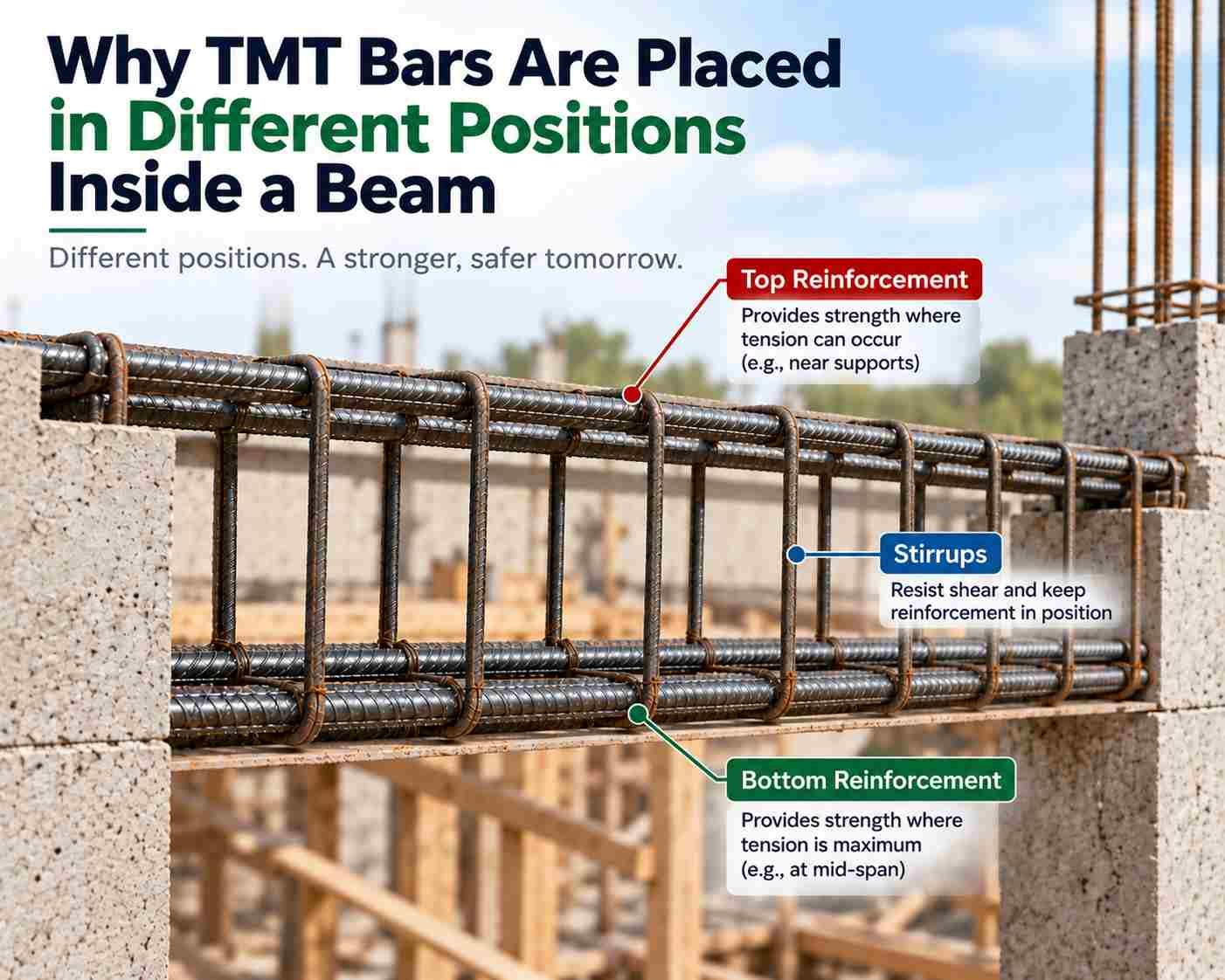
Also Read: Why TMT Bars Are Placed in Different Positions Inside a Beam
If the interface contains poorly bonded areas or connected voids, water may find a path through the concrete. This can be a concern in exposed or water-retaining structures and in locations where moisture could reach embedded reinforcement.
Water penetration is not inevitable in every cold joint. It depends on the quality and continuity of the interface, the exposure conditions and the concrete’s overall permeability.
A joint may appear as a line, change in colour or visible boundary between two placements. Such a line can be an indication that the concrete was placed in separate stages, but appearance alone cannot establish whether the joint is structurally acceptable.
Conversely, a joint that is not obvious on the surface should not automatically be assumed to be sound.
Once the concrete has hardened, the interface is concealed within the member. If the joint is in a critical location, determining its condition may require professional inspection, testing or a more detailed engineering assessment.
This is why identifying and documenting interruptions while the work is taking place is more useful than relying on visual inspection after the formwork has been removed.
Prevention starts before the concrete mixer or truck reaches the site. The aim is to maintain a suitable placement sequence and avoid delays that allow earlier concrete to set before the next placement can integrate with it.
Estimate the concrete volume and establish a realistic placement sequence based on the approved drawings, the site’s access and the available equipment.
Coordinate the delivery schedule with the batching plant, pump operator and site supervisor. The plan should account for practical constraints instead of assuming that every load will arrive exactly on time.
For larger pours, agree in advance on how the team will respond if supply or equipment fails.
Check the pump, delivery lines, vibrators, backup arrangements and communication between the team members before starting.
If the pour depends on one piece of equipment, consider the consequences of its failure and arrange an appropriate contingency. Equipment availability alone is not enough; trained personnel must also be available to place and compact the concrete correctly.
Concrete should be placed in the sequence and locations specified by the construction method and structural requirements.
The team should avoid leaving isolated sections unfinished without understanding how the interruption could affect the next placement. Where staged placement is required, the joint location and preparation should be established in advance.
Do not choose an arbitrary joint location simply because it is convenient for the workers.
Before starting, check the weather outlook and prepare suitable protection where rain is a possibility. Arrange coverings and site measures that reduce the risk of uncontrolled water entering the fresh concrete or disrupting the placing sequence.
If conditions force work to stop, the supervisor should document what happened and obtain technical guidance on the next step.
Even a well-planned pour can be interrupted. The important thing is to respond in a controlled way rather than treating every delay as a minor inconvenience.
Step 1: Record the interruption.
Note the location of the pour, the time work stopped, the concrete already placed and the reason for the delay. This information helps the engineer understand the sequence of events.
Step 2: Assess the condition of the concrete.
The team should determine whether the earlier concrete is still suitable for continued placement under the approved procedure. Elapsed time alone is not enough to make this decision.
Step 3: Do not resume blindly.
If the concrete has begun setting and proper integration is doubtful, do not simply place fresh concrete over it and assume that vibration will resolve the problem.
The appropriate response depends on the structural element, the location of the interface and the condition of the existing concrete.
Step 4: Contact the responsible engineer when necessary.
If the interruption creates an unplanned joint or the team is unsure whether the next placement can proceed safely, obtain engineering guidance. The engineer may need to determine whether the interface can be treated through an approved procedure or whether further assessment is required.
Step 5: Follow the approved remedial procedure.
Depending on the circumstances, the solution may involve specified surface preparation, treatment of the interface or another engineered measure. A critical structural joint may require further inspection or testing before remedial work is approved.
Do not apply a generic repair method to every cold joint. The correct treatment depends on the location, structural demands and actual condition of the concrete.
A cold joint is primarily a concrete-placement and interface issue. It does not automatically mean that the TMT bars inside the member have failed or lost their material properties.
However, reinforcement and concrete work together in an RCC structure. If a joint affects the transfer of forces, concrete cover, durability or the bond between steel and surrounding concrete, the overall performance of the reinforced concrete member may be affected.
For example, an interface that permits moisture to reach embedded steel could increase durability concerns under suitable exposure conditions. The significance depends on the condition of the concrete and the protection provided to the reinforcement.
Using compliant TMT bars remains important, but steel quality cannot compensate for an inadequately formed concrete joint. Reinforcement detailing, concrete placement, compaction and curing must all meet the project’s requirements.
For contractors sourcing reinforcement steel, Kenza TMT Steel Bars provides TMT reinforcement products for construction applications. The grade and specifications selected for a project should always match the approved structural design.
Also Read: Why TMT Bars Need Proper Concrete Cover: A Simple Guide for Homeowners
Use this checklist during the pre-pour discussion with the site team:
This checklist will not eliminate every possible interruption, but it helps the team identify preventable problems before they affect the concrete.
Cold joints are often associated with delays during concrete pouring, but the underlying issue is whether the successive placements can integrate properly. A delayed truck, equipment failure or sudden change in weather can disrupt the work, yet the outcome depends on the concrete’s condition and the location and function of the interface.
For contractors and site supervisors, good preparation is the first line of prevention. Plan deliveries, keep equipment ready, follow the approved placing sequence and establish a clear response for unexpected interruptions.
If a cold joint may have formed, do not judge its severity by appearance alone or assume that placing more concrete will solve the problem. Record the circumstances and obtain the appropriate engineering assessment.
Good construction practice depends on the complete process: suitable materials, correct structural detailing, controlled concrete placement and proper execution. Each contributes to the performance and durability expected from a reinforced concrete structure.