Fire safety is a critical aspect of structural design, yet it is often overlooked during home construction. While homeowners typically focus on visible elements such as flooring, roofing, and interior finishes, the strength and performance of the structural framework during extreme conditions are equally important.
A common misconception is that TMT bars are completely fireproof. They are not. Like all structural steel, TMT bars gradually lose strength when exposed to very high temperatures. However, high-quality TMT bars are designed to retain their structural integrity for longer at elevated temperatures, especially when used as part of a properly designed reinforced concrete system.
Understanding how TMT bars respond to heat helps homeowners, builders, and engineers make informed construction decisions that improve long-term safety.
In this guide, we’ll cover:
Although major building fires are uncommon, smaller fires occur more frequently than many homeowners realize.
Kitchen fires, electrical short circuits, inverter failures, LPG leaks, and accidental ignition during renovation work can expose parts of a building to extremely high temperatures.
The goal of structural fire resistance is not to make a building immune to fire.
Instead, it is to:
Every component of a reinforced concrete structure contributes to achieving these objectives.
Steel does not suddenly fail when exposed to fire.
Instead, its mechanical properties gradually change as temperature increases.
As the temperature rises:
This process occurs progressively rather than instantly.
That is why engineers evaluate both temperature and duration of exposure after a fire instead of assuming the reinforcement has failed.
Modern TMT bars are manufactured using a thermo-mechanical treatment process that creates two important characteristics:
This unique microstructure allows TMT bars to perform better under demanding structural conditions than conventional mild steel reinforcement.
During elevated temperatures, this ductility becomes especially valuable because it allows the reinforcement to deform before failure rather than behaving in a brittle manner.
While no reinforcement steel is completely fireproof, properly manufactured TMT bars help structures maintain stability for a longer period during fire exposure.
One of the biggest misconceptions is that fire resistance depends only on the TMT bars.
In reality, reinforced concrete works as a single structural system.
Concrete performs an important protective function because it surrounds the reinforcement and slows the transfer of heat.
This concrete cover acts as an insulating layer, delaying the temperature rise inside the embedded TMT bars.
The thicker and better-quality the concrete cover, the longer it generally takes for heat to reach the reinforcement.
This is one reason why structural engineers carefully specify concrete cover during construction.
Without adequate cover, reinforcement heats up much faster during a fire.
Concrete cover refers to the thickness of concrete between the outer surface of the reinforcement and the exposed surface of the structural member.
It serves several purposes:
Proper concrete cover is just as important as selecting high-quality TMT bars.
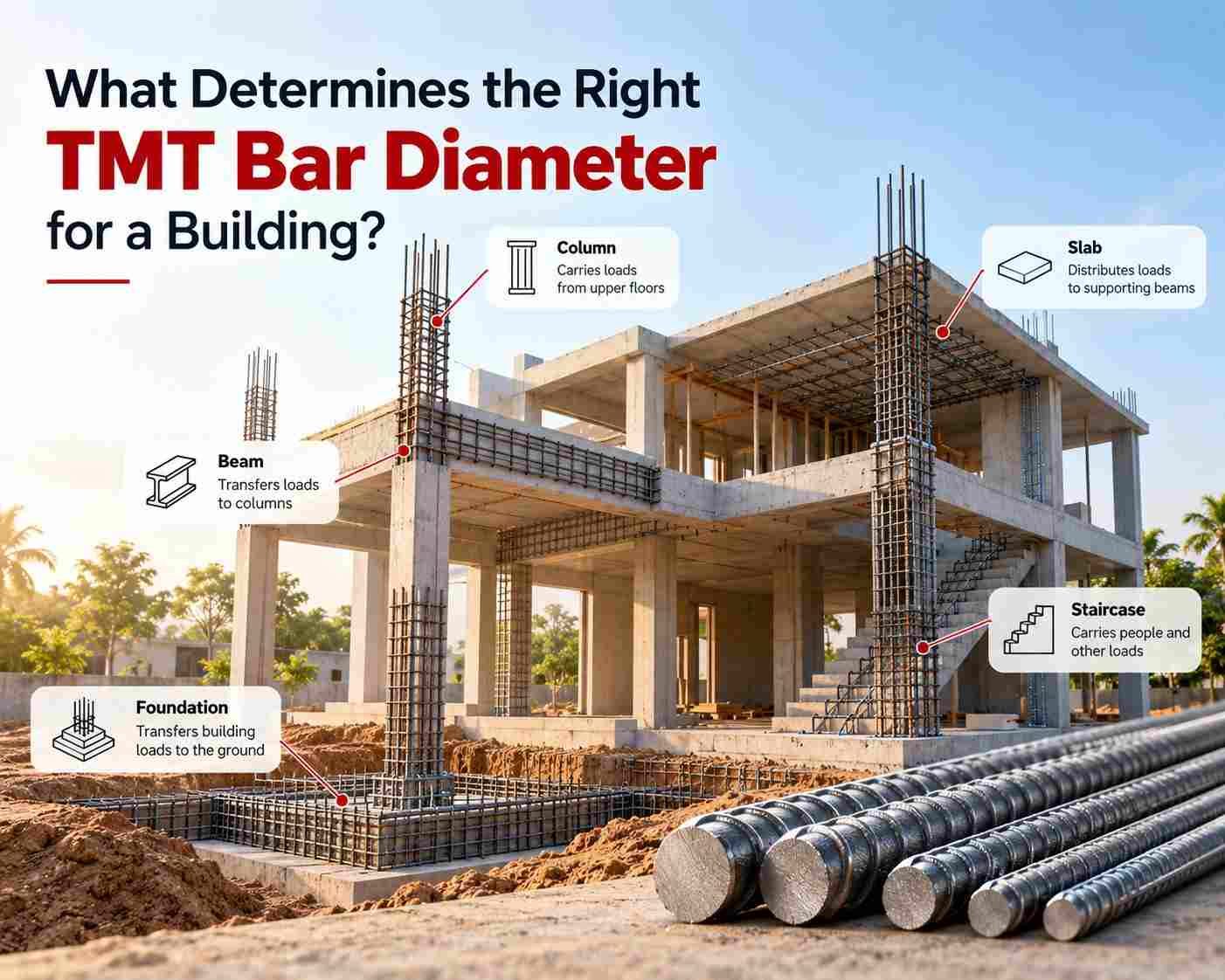
Different structural elements experience heat differently.
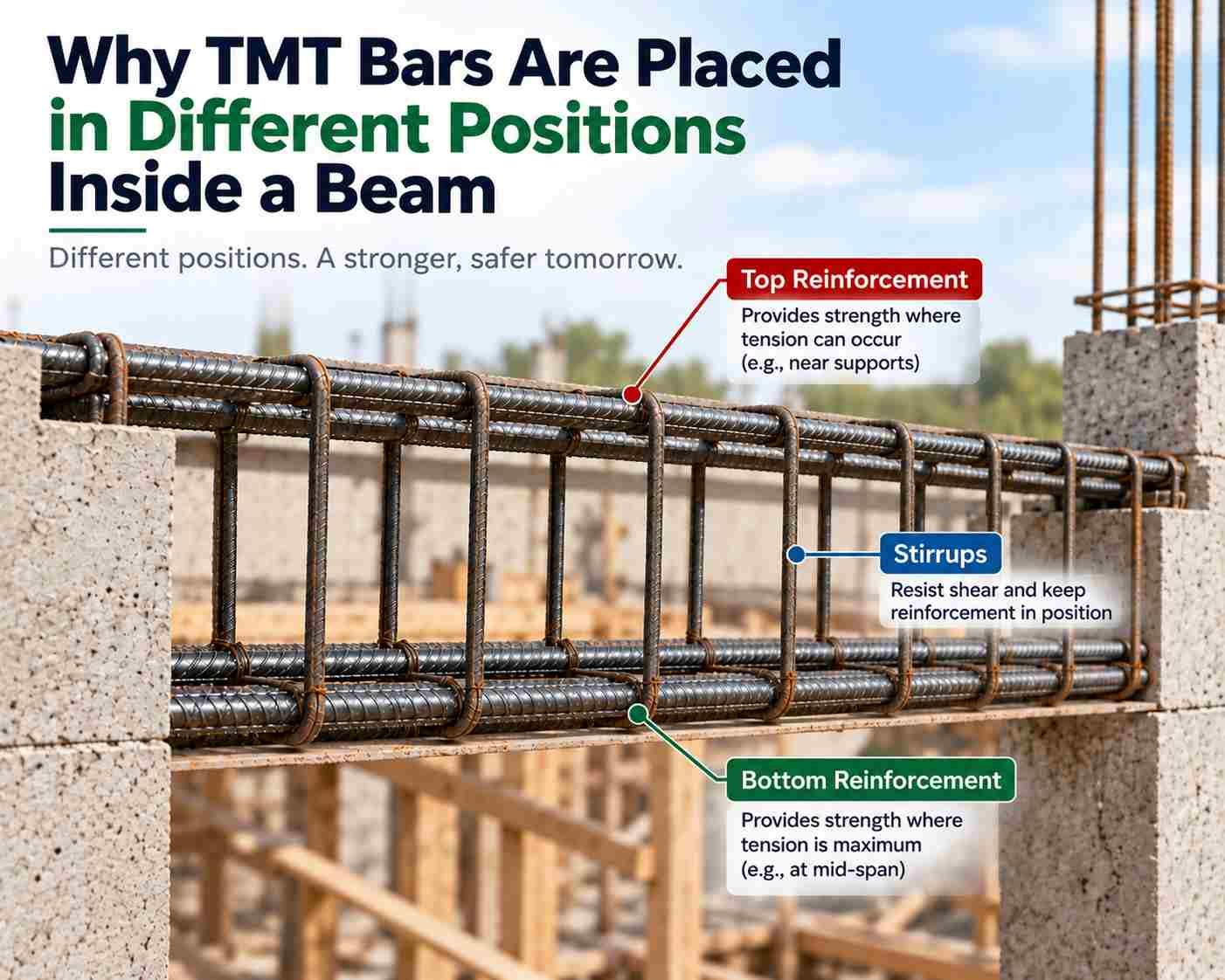
Beams support floor loads.
Prolonged heating can reduce their load-carrying capacity if temperatures become excessive.
Columns carry the weight of the entire building.
Protecting reinforcement inside columns is critical because column failure can significantly affect structural stability.
Floor slabs usually experience distributed heating.
Concrete cover helps delay heat reaching the reinforcement.
Reinforced concrete staircases often serve as emergency escape routes.
Maintaining their structural integrity during fire is essential for safe evacuation.
Consider a warehouse that experiences a prolonged fire affecting a large section of the building.
Because temperatures remain high for an extended period, engineers perform a detailed structural assessment before allowing the building to be reused.
The inspection may include:
Depending on the findings, some structural members may only require repairs, while others may need strengthening or replacement.
This illustrates why post-fire engineering evaluation is essential for major fire incidents.
Not all TMT bars are manufactured with the same level of process control.
Consistent manufacturing contributes to:
For homeowners, choosing certified TMT bars from a trusted manufacturer helps ensure the reinforcement performs as intended throughout the life of the structure.
Kenza TMT manufactures certified Fe 550 SD CRS TMT bars through controlled manufacturing processes, delivering the consistency required for modern reinforced concrete construction.
Fire resistance and corrosion resistance are different properties.
However, both contribute to long-term structural durability.
Corrosion gradually weakens reinforcement over many years.
Fire subjects reinforcement to short-term but extremely high temperatures.
High-quality CRS TMT bars help protect structures against corrosion throughout their service life while also providing the strength and ductility expected from modern reinforcement steel.
Together, these characteristics improve the overall durability of reinforced concrete structures.
Also Read: Fire Resistance of TMT Bars: What Really Happens to Your Building’s Steel in a Fire
Myth: TMT bars are completely fireproof.
Reality:
No structural steel is completely fireproof. TMT bars gradually lose strength as temperatures rise, but quality reinforcement helps structures perform better during fire exposure.
Myth: If the building is still standing, it is completely safe.
Reality:
Only a qualified structural engineer can determine whether reinforcement has been affected after a fire.
Myth: Fire only damages concrete.
Reality:
Both concrete and reinforcement can be affected depending on the fire intensity and duration.
Myth: Thicker TMT bars automatically provide better fire resistance.
Reality:
Fire performance depends on the complete structural design, concrete cover, reinforcement detailing, and engineering—not simply bar diameter.
Improving fire performance involves much more than selecting the right reinforcement.
Good construction practices include:
When these practices are combined, the reinforced concrete structure performs more reliably during unexpected fire events.
Homeowners usually cannot see the reinforcement once construction is complete.
This makes quality even more important.
Certified TMT bars provide confidence that the reinforcement meets established mechanical property requirements for strength and ductility.
Instead of selecting steel based only on price, homeowners should consider:
These factors influence the long-term performance of the entire structure.
Fire safety is not determined by a single construction material.
It depends on the combined performance of reinforcement steel, concrete, structural design, workmanship, and adherence to engineering standards.
High-quality TMT bars improve structural safety during fire, but no steel is completely fireproof. Their ability to maintain strength, work together with concrete, and provide ductility under demanding conditions makes them an essential component of modern reinforced concrete construction.
Choosing certified Kenza TMT bars, ensuring adequate concrete cover, and following structural engineering recommendations can help create stronger, more durable buildings that are better prepared for unexpected conditions.
Are TMT bars fireproof?
No. TMT bars are not completely fireproof. They gradually lose strength at elevated temperatures, but high-quality TMT bars are designed to perform reliably as part of a reinforced concrete system during fire exposure.
Do TMT bars melt during a house fire?
Typical residential fires are generally far below steel’s melting point. However, prolonged exposure to high temperatures can reduce the strength and stiffness of reinforcement, which is why post-fire structural assessments are important.
Why is concrete cover important during a fire?
Concrete cover slows the transfer of heat to embedded reinforcement, helping the TMT bars remain at lower temperatures for a longer period.
Can a building be reused after a fire?
It depends on the severity of the fire. A qualified structural engineer should inspect the building and determine whether repairs, strengthening, or replacement of structural members are necessary.
Does corrosion-resistant TMT steel improve fire resistance?
Corrosion resistance and fire resistance are different properties. Corrosion-resistant TMT bars help improve long-term durability, while fire performance depends on the reinforced concrete system, including the quality of the steel, concrete cover, and structural design.