A building does not fail the moment a fire starts. It fails when the steel inside can no longer carry the load above it.
Understanding the fire resistance of TMT bars is not just academic knowledge for structural engineers. It is practical information that matters to every homeowner, contractor, and developer in Kerala — where high-rise apartments, dense urban construction, and LPG-dependent kitchens create real fire risk in real structures.
This blog explains exactly what happens to TMT bars at each temperature stage during a fire, why the quality of the bar determines how long a structure holds, what concrete cover does to protect steel, and why Kenza TMT Fe 550 SD gives your building the best fire behaviour available in this grade.
The fire resistance of TMT bars is a direct result of their manufacturing process, specifically the Thermex quenching and self-tempering stages that create the bar’s dual microstructure.
Conventional mild steel bars have a uniform microstructure throughout, no distinction between outer and inner zones. Under fire loading, the entire cross-section heats uniformly and softens at the same rate. TMT bars heat from the outside in, and the dual microstructure gives the inner core additional time before reaching critical temperatures.
This is why TMT bars give a burning structure more time than conventional steel — not indefinitely, but enough.
This is the information most fire-related construction guides skip. Understanding how steel behaves at each temperature stage explains why quality and grade matter so much for fire safety.
| Temperature | What Happens to the Steel | Strength Retention | Structural Implication |
| Up to 300°C | Minor softening begins. Tempered martensite layer remains largely intact. Minimal strength loss. | ~95 to 100% | Structure fully functional. Fire still manageable. |
| 300°C to 400°C | Strength begins to decline measurably. Young’s Modulus (stiffness) starts reducing. Thermal expansion increases. | ~80 to 95% | Load-bearing elements remain safe. Evacuation window fully open. |
| 400°C to 500°C | Significant strength loss begins. Martensite layer starts to temper back toward softer structure. Deformation increases under sustained load. | ~65 to 80% | Critical period — structure still standing but approaching limits. |
| 500°C to 600°C | Rapid strength loss. Quality TMT bars retain approximately 60% of original yield strength at 600°C. Conventional steel retains less. | ~40 to 60% | Structural risk is real. Emergency response and evacuation critical. |
| Above 600°C | Permanent microstructural damage. Martensite layer breaks down irreversibly. Rapid deformation under load. Progressive failure risk. | Below 40% | Structural collapse risk. Post-fire reuse requires full engineering assessment. |
| Above 700°C | Full microstructural breakdown. Bar loses most mechanical properties. Deformation and buckling under minimal load. | Below 20% | Structural failure highly likely. Building unsafe. |
600°C is the critical dividing line for TMT bars in fire. Below this temperature, high-quality TMT bars may retain enough structural contribution to keep a building standing during the fire. Above this temperature, permanent microstructural changes occur and the bar’s properties do not fully recover even after cooling. This is why post-fire structural assessments specifically check whether steel temperatures exceeded 600°C during the event.
A fire in a real building does not heat every structural element equally. Three zones develop as a fire progresses, and each zone presents a different level of risk to the TMT reinforcement.
The room or floor of origin. Temperatures typically reach 600°C to 900°C or higher within 20 to 45 minutes of ignition in a fully developed building fire. Structural elements in this zone like columns, beams, slabs face the most severe heat exposure.
Steel in this zone depends entirely on the concrete cover thickness to delay heat penetration. A slab with 20mm cover and a column with 40mm cover will see very different steel temperatures at the 30-minute mark of a fire even in the same building.
Adjacent floors, corridors, and connected spaces. Temperatures here typically reach 200°C to 400°C — below the critical threshold for structural steel but still damaging to concrete over extended exposure. In multi-storey buildings, this zone can extend two to three floors above and one floor below the fire floor through stairwells, lift shafts, and structural connections.
The rest of the building. Temperatures may be ambient, but the structure above the fire floor carries redistributed loads from any weakening of elements below. In progressive collapse scenarios, this load redistribution is what causes floors or columns outside the fire zone to fail.
The most important fire protection mechanism for reinforcement steel is not the bar itself, it is the concrete surrounding it. Concrete is an excellent thermal insulator. A standard concrete column with 40mm cover can delay the steel inside from reaching 300°C for 30 to 60 minutes, depending on fire intensity.
| Structural Element | IS 456 Minimum Cover | Fire Resistance Rating | Kerala Recommendation |
| Slab | 20mm | 1 hour (standard) | 25mm minimum — coastal districts |
| Beam | 25mm to 40mm | 1 to 2 hours | 40mm for high-occupancy buildings |
| Column | 40mm | 1.5 to 2 hours | 50mm for high-rise structures |
| Foundation | 50mm to 75mm | Direct soil contact — corrosion focus | 75mm in waterlogged zones |
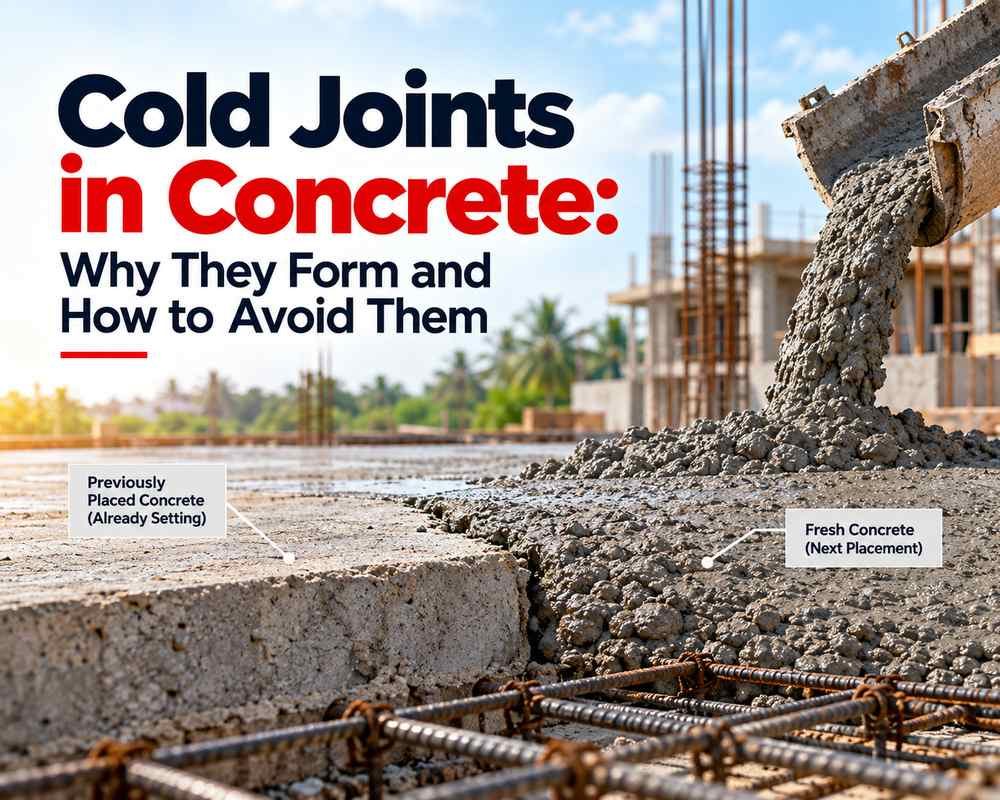
When concrete cover is inadequate, a very common construction defect in Kerala — steel reaches critical temperatures faster. A column with 25mm cover instead of the specified 40mm will see its steel temperature rise significantly faster in a fire, reducing the available evacuation time.
At temperatures above 300°C, moisture trapped in concrete converts to steam under pressure. This steam can cause explosive spalling — chunks of concrete breaking away from the structural element. Spalling removes the concrete cover protecting the steel and suddenly exposes reinforcement directly to fire temperatures. Once spalling begins, the steel’s temperature rises rapidly and structural failure accelerates significantly.
Steel expands when heated. The coefficient of thermal expansion for structural steel is approximately 12 × 10⁻⁶ per °C. A 6-metre TMT bar heated from 25°C to 500°C expands by approximately 34mm.
In a fire, this expansion happens rapidly and in a constrained environment, the concrete does not expand at the same rate. This creates bond stress between the steel and the surrounding concrete. In extreme cases, the expanding steel pushes outward against the concrete cover from the inside, accelerating spalling and further exposing the reinforcement.
High-quality TMT bars have consistent rib geometry that maintains the concrete-steel bond more effectively under thermal stress. Inconsistent or shallow ribs found on substandard bars allow microslippage earlier in the fire event, reducing the bond before temperatures even reach critical levels.
Kerala’s construction landscape creates specific fire risk profiles that make TMT bar fire resistance directly relevant to homeowners and builders.
The fire resistance of TMT bars is partly a function of their chemical composition. Specifically:
Kenza TMT manufactures every bar from 100% virgin steel. Every batch is tested for carbon, sulfur, and phosphorus content before dispatch. The mill test certificate accessible by scanning the barcode on each bundle, confirms the chemical composition that underpins fire performance.
At what temperature do TMT bars lose structural strength?
Strength loss begins measurably around 300°C and accelerates significantly above 400°C. Quality TMT bars retain approximately 80% of their yield strength at 500°C — a critical advantage during evacuation. Above 600°C, strength drops rapidly and permanent microstructural damage occurs. At 700°C, yield strength is below 20% of the original value.
Can a building be reused after a fire?
It depends on what temperatures the steel reached. If steel stayed below 600°C throughout, and concrete cover remained largely intact, repair and reuse may be feasible after detailed structural assessment. If steel exceeded 600°C — indicated by concrete discolouration above grey-buff, significant spalling, or visible bar distortion — the structural elements affected typically require replacement rather than repair.
Does concrete cover protect the steel from fire?
Yes, significantly. Concrete is an excellent thermal insulator. A column with 40mm cover can delay the steel inside from reaching 300°C for 30 to 60 minutes in a standard building fire. This is why IS 456 specifies minimum concrete cover requirements and why Kerala’s coastal construction context demands cover at or above the upper end of those ranges.
Is Fe 550 SD better than Fe 500D in a fire?
Both grades have similar fire resistance characteristics because they share the same dual microstructure from the Thermex quenching process. The key difference in fire performance between brands is not the grade designation, it is the chemical composition quality of the billet used. Virgin steel billets with controlled carbon, sulfur, and phosphorus content produce bars that behave more predictably under high-temperature loading than bars made from variable scrap-based billets.
A building’s ability to withstand fire is not determined by what happens on the day of the fire. It is determined by decisions made years before — during design, material specification, and construction.
The fire resistance of TMT bars is real — but only as reliable as the steel behind it. Quality bars give a burning structure time. Minutes, not hours. But minutes that save lives. That time depends on the concrete cover staying intact, the grade meeting the structural demand, and the bars themselves being made from consistent, virgin steel with controlled quenching. Substandard bars made from variable scrap billets behave unpredictably under fire loading. The window of safety shrinks — and with it, the time available for evacuation.
Kenza TMT Fe 550 SD is manufactured from 100% virgin steel billets using German rolling mill technology. Every batch is chemically tested before dispatch. Every bundle is barcode-tagged for full traceability. The result is a bar whose fire resistance behaviour is consistent, the same from the first bar to the last bar in every structure it reinforces.