Reinforcement mistakes in construction are the most dangerous kind, because you cannot see them after the concrete is poured.
When your home is being built, dozens of decisions are made on site every day by your contractor, site supervisor, and labour team. Most of these happen when you are not there. And the most critical ones involve the steel reinforcement placed inside your columns, beams, slabs, and foundation before concrete covers everything permanently.
Once concrete is poured, what is underneath is fixed. You cannot reopen a column to reposition a bar. You cannot add concrete cover to a slab after the fact. Steel bar placement mistakes made on site become permanent — working silently against your structure for the next 30, 40, or 50 years.
In Kerala, this risk is even higher. Monsoon humidity, coastal salt air, and seismic zones already put daily pressure on buildings. A construction mistake that takes 25 years to show damage in a dry climate can appear in just 8 to 10 years in a coastal Kerala district.
If the tiles on your floor are laid poorly, you replace the tiles. If the paint is the wrong colour, you repaint. These errors are visible, fixable, and affordable.
Reinforcement errors are none of those things. By the time a reinforcement mistake becomes visible, a crack on a beam, a rust stain on a column, concrete spalling off a slab the damage has been accumulating for years. The repair is not cosmetic. It is structural. Column jacketing, crack injection, concrete chipping and restoration these cost lakhs, with the disruption of partially vacating a home that should never have needed this work.
The only time to get reinforcement right is before the concrete goes in. After that, the window is closed.
This is the mistake that happens before a single bar reaches the site and it is the one most buyers make without realising it. Different structural elements have different demands. Using Fe 500 where the structural design calls for Fe 550 SD either to save cost or because the dealer supplied it without checking, means the structure is performing below its designed capacity from day one.
Grades such as Fe 415, Fe 500, and Fe 550 refer to the yield strength of the bars in megapascals. Selecting a grade that does not match the structural requirement may damage the structure tremendously.
The Kerala angle: In seismic zones like Idukki, Wayanad, and Palakkad, and in coastal districts like Kozhikode and Thrissur, structural designs typically specify Fe 550 SD with Special Ductility and CRS certification. Supplying Fe 500 instead saves roughly Rs. 2 to Rs. 4 per kg — but compromises the entire seismic and corrosion resistance strategy built into the design.
When a contractor runs out of bars mid-project and buys the remaining quantity from a different brand or batch — the two sets of bars may have meaningfully different yield strengths, elongation percentages, and rib geometry. The structure ends up with inconsistent reinforcement properties across its elements.
Mixing different steel brands in one project can create uneven structural performance. Under seismic or wind load, weaker bars reach their yield point first, creating localised failure points within an apparently sound structure.
How to prevent it: Order the full quantity of TMT bars required for the entire project in advance. Work with an authorised distributor who guarantees consistent supply from the same manufacturer throughout the project.
Concrete cover is the thickness of concrete between the outer face of the structure and the nearest steel bar. It is the bar’s only protection against moisture, chlorides, and carbonation. IS 456 specifies minimum cover — 25mm for slabs, 40mm for columns, 50mm for foundations in mild conditions. In Kerala’s coastal districts, these minimums increase significantly.
On most Indian construction sites, cover blocks are either not used, placed inconsistently, or compress under wet concrete weight. Bars end up closer to the surface than designed.
The Kerala angle: Inadequate cover in coastal districts can reduce the onset of visible corrosion from 20 to 25 years down to 8 to 12 years.
How to prevent it: Use factory-made concrete cover blocks of the correct thickness, never improvised substitutes. Inspect cover block placement before every pour. Assign one person on site whose job during the pour is to verify bars have not shifted and covers are in place.
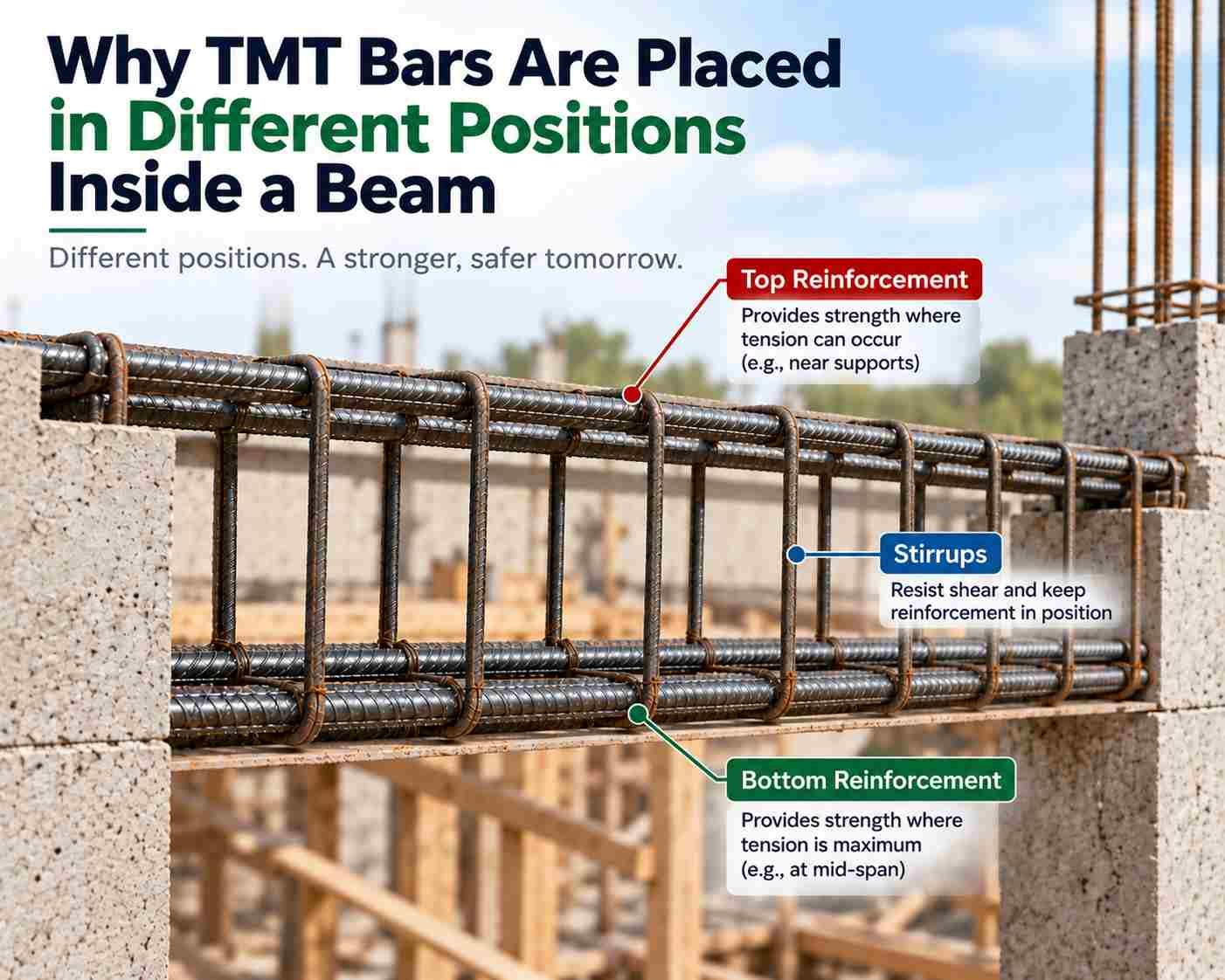
Bar spacing is calculated to ensure load is distributed evenly across a structural element. On site, bars get pushed together or spread apart. Either way, the design intent is broken.
Zones with bars too close together get insufficient concrete flow causing honeycombing. Zones with bars too far apart carry more load per bar than designed, accelerating fatigue under repeated loading.
How to prevent it: Use the Bar Bending Schedule as the site reference for every element. Mark spacing positions on formwork before placing bars. Check spacing with a measuring tape, not by eye.
Bars stored directly on soil, exposed to monsoon rain, or in contact with oil, paint, or chemicals are compromised before they are placed. Heavy rust, flaking, oil contamination, or mud coating create a weak interface between bar and concrete, reducing the bond strength the structural design depends on.
The Kerala storage problem: Kerala’s monsoon lasts 4 to 5 months. Bars stored on open sites without cover during this period develop surface contamination that significantly reduces bond strength.
How to prevent it: Store bars off the ground on wooden sleepers. Cover stored bars with tarpaulin during rain. Clean bars with wire brushing before placement if contamination is present. Never store bars in contact with chemicals or fertilisers.
When a reinforcement bar ends and a new one begins, the two bars overlap for a specified lap length. This ensures force transfers fully between bars. Shortcuts on lap length to reduce material consumption are among the most common reinforcement mistakes on Indian construction sites.
What it causes: Joints that cannot transfer their full design load. Under seismic stress, under-lapped joints become the first failure points in a structure.
How to prevent it: Follow the structural engineer’s lap length specifications exactly. Stagger lap positions, never lap all bars at the same cross-section, as this creates a concentrated weak zone.
Reinforcement placement is approved. The pour begins. As the vibrator moves, as workers walk on the cage, as concrete is poured from height, bars shift. By the time the concrete sets, bars are no longer where the drawing specified.
Movement due to vibration or poor support during concreting leads to loss of effective structural depth, directly impacting load-bearing performance.
How to prevent it: Tie all bar intersections properly. Install bar chairs that remain stable under wet concrete weight. Never allow workers to walk directly on reinforcement cages during pouring. Assign a dedicated supervisor to monitor bar positions during every pour.
TMT bars must be bent at specific angles and radii. Hooks at bar ends provide anchorage, preventing bars from pulling out under tensile load. Bars bent too sharply at smaller radii than specified can crack the outer surface and reduce load-carrying capacity at that point.
What it causes: Reduced anchorage strength. Under seismic load, bars without proper hooks can pull out of beam-column joints, one of the most catastrophic failure modes in RCC structures.
How to prevent it: Use proper bar bending machines calibrated to specified bend radii. Follow IS 2502 for bending and hook geometry. Never heat TMT bars to ease bending, this destroys the tempered martensite outer layer that gives the bar its strength.
At beam-column joints, reinforcement from multiple elements converges. When bars are too crowded, concrete cannot flow around them properly, causing honeycombing — voids in the concrete with significantly reduced compressive strength.
The Kerala angle: Honeycombing at beam-column joints in coastal Kerala districts is among the fastest pathways to structural deterioration — salt air enters through voids and reaches steel directly.
How to prevent it: Follow the specified bar layout at joints exactly. If congestion appears unavoidable, consult the structural engineer before proceeding. Use self-compacting concrete (SCC) for heavily congested sections.
When a structural engineer designs a reinforcement layout, every decision is calculated. Changing any element on site — bar diameter, spacing, cover, grade, lap length without structural approval invalidates the design assumption for that element.
Common unauthorised changes: reducing bar diameters to use available stock, increasing spacing to save material, omitting stirrups in sections that look fine, and shifting slab openings without recalculating reinforcement.
How to prevent it: Any change from the structural drawing must go back to the structural engineer for written approval before execution. No exceptions.
Also Read: The Real Role of TMT Bars in Construction — And Why Quality Changes Everything
Every reinforcement mistake above affects structures everywhere. In Kerala, the consequences arrive faster and cost more.
Understanding the financial stakes changes how seriously buyers and contractors take reinforcement quality.
| Mistake | If Caught During Construction | If Found After Completion |
| Wrong grade bars | Replace bars — material cost only | Column jacketing or structural intervention — Rs. 2 to Rs. 8 lakhs |
| Inadequate cover | Adjust before pour — no cost | Concrete repair, anti-carbonation coating — Rs. 50,000 to Rs. 3 lakhs |
| Displaced bars | Reposition before pour — no cost | Structural assessment and repair — Rs. 1 to Rs. 5 lakhs |
| Poor lapping | Redo before pour — labour cost | Joint strengthening intervention — Rs. 1 to Rs. 4 lakhs |
| Honeycombing | Recast element — material + labour | Concrete injection, section repair — Rs. 50,000 to Rs. 2 lakhs |
Every single mistake costs nothing to prevent. Every single mistake costs lakhs to repair after the fact.
Some reinforcement mistakes are purely execution errors, no TMT bar can prevent those. But several critical mistakes are directly connected to the quality of the steel itself.
Every reinforcement mistake in construction shares one defining characteristic, it gets hidden. Concrete goes in, shuttering comes off, plastering covers the walls, and the structure looks complete. Nobody can see what is underneath.
But the steel can feel it. Every monsoon that saturates the concrete. Every tremor that cycles stress through the bars. Every year that chlorides from coastal air creep closer to the steel surface.
Getting reinforcement right is not complicated. It requires the right bars, confirmed grade, proper placement, correct cover, disciplined site supervision, and a contractor who follows drawings rather than shortcuts. None of these are expensive. All of them are available.
Kenza TMT Bars gives you the right starting point — BIS-certified, CRS-rated, virgin steel billets, German technology, and batch-level traceability that puts quality verification in your hands before concreting begins.