Your building looks like concrete on the outside. But what holds it together is steel.
Every column, beam, foundation, and slab in your home contains a hidden skeleton, a network of TMT steel bars embedded inside concrete, working invisibly to keep your structure safe. Concrete is excellent under compression, it resists being crushed. But the moment a structure faces tension, bending, wind load, or an earthquake, concrete cracks. TMT bars are what prevent that crack from becoming a collapse.
In Kerala, where buildings face 3,000+ mm of annual rainfall, salt-laden coastal air, and seismic zones across Idukki, Wayanad, Palakkad, and Kozhikode — the role of TMT bars goes beyond construction textbooks. It is a daily, real-world test of structural survival.
This blog breaks down everything that matters from what actually happens inside a TMT bar during manufacturing, to how it performs in every part of your home, from the foundation right up to the roof slab. You will understand what quality really means beyond the marketing, why Kerala’s unique conditions demand more than the standard grade
Concrete handles compressive loads, the forces that try to crush. Steel handles tensile loads, the forces that try to pull, stretch, or bend.
In a reinforced cement concrete (RCC) structure, concrete and TMT bars work as a composite, each doing what the other cannot. Remove the steel, and concrete cracks under any tensile stress. Remove the concrete, and steel buckles under compression. Together, they create one of the strongest structural systems in modern construction.
Understanding the manufacturing process explains why not all TMT bars are equal and why the technology behind the bar matters as much as the grade printed on it.
Raw steel billets are heated to over 1,100°C and rolled through a series of mill stands to produce bars of the required diameter — 8mm, 10mm, 12mm, 16mm, 20mm, 25mm, or 32mm. The quality of the billet at this stage determines the chemical consistency of the final bar. Virgin steel billets made from refined iron ore — give uniform carbon, sulfur, and phosphorus content. Scrap-based billets introduce impurities that weaken the bar unpredictably.
The hot-rolled bar passes immediately through a Thermex quenching box, a controlled water cooling chamber. Cold water jets rapidly cool the outer surface, forming a hard outer layer called martensite. The core stays hot and austenitic at this stage.
This is the most critical step. The precision of the quenching temperature and duration determines the thickness and uniformity of the martensite layer — which directly controls yield strength. Too fast, and the bar becomes brittle. Too slow, and the strength gain is lost.
Kenza TMT uses German rolling mill technology, the same engineering origin as the Thermex process — ensuring microprocessor-controlled, consistent quenching across every bar in every batch.
Once the bar exits the quenching box, residual heat from the hot inner core flows outward toward the cooled martensite surface. This natural heat exchange automatically tempers the martensite layer, forming tempered martensite. Tempering reduces brittleness while preserving high yield strength, no external energy required.
The bar is placed on a cooling bed at room temperature. During this final stage, the austenitic core transforms into a fine-grained ferrite-pearlite structure. The soft, flexible inner core that gives TMT bars their elongation and ductility.
The result: hard and strong on the outside, flexible and tough on the inside. This is what allows Fe 550 SD to carry enormous loads without snapping — and to bend under earthquake stress without fracturing.
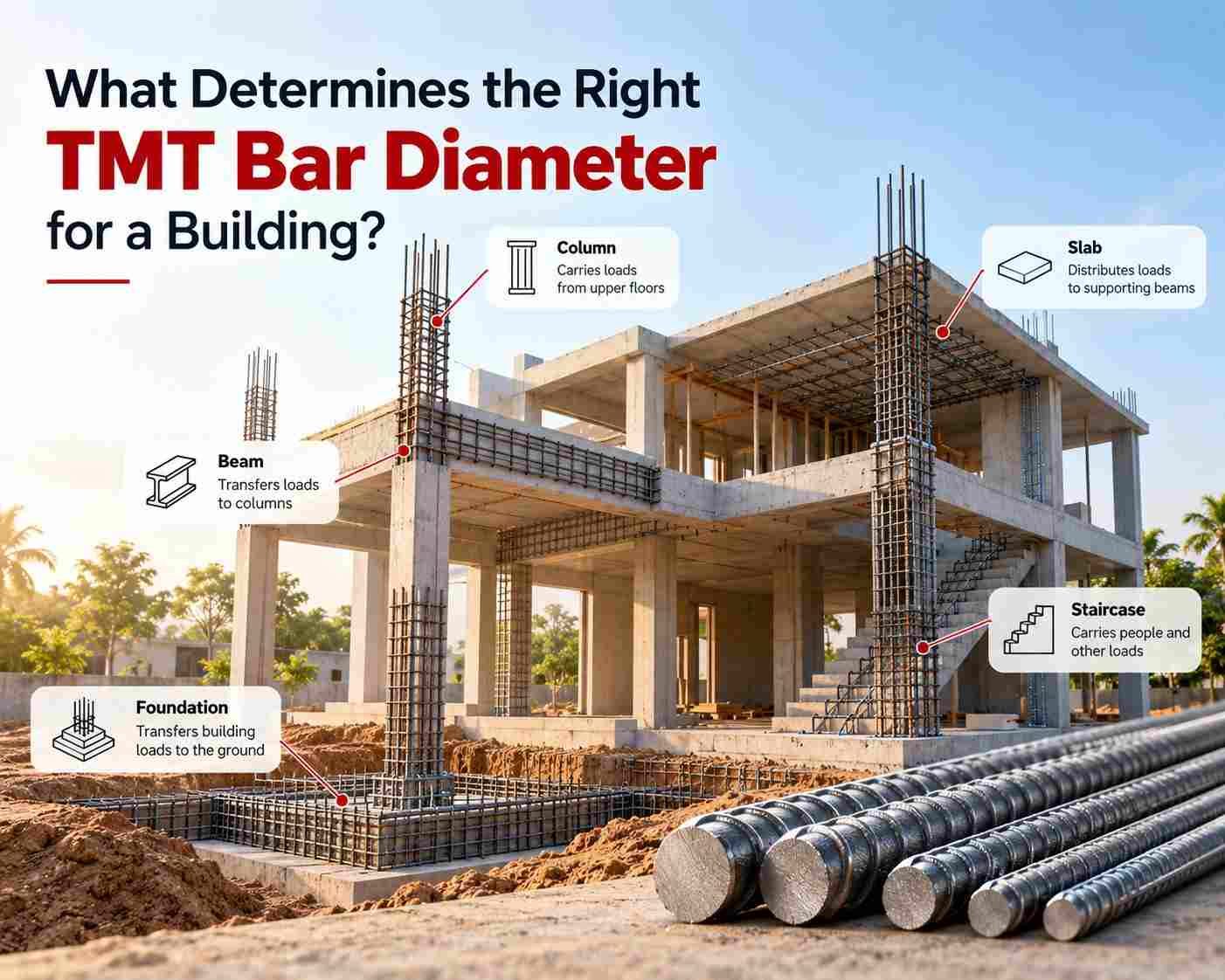
A home is not one single structure. It is a system of interconnected structural elements, each with specific loads, stresses, and TMT requirements.
The foundation is where your entire home’s weight meets the earth. TMT bars here resist:
Recommended grade: Fe 500D or Fe 550 SD. In areas with high water table or flood risk — Alappuzha, Kottayam, coastal Kozhikode — CRS-certified Fe 550 SD is strongly preferred.
Bar sizes used: 12mm to 20mm main bars, 8mm to 10mm stirrups
Columns are vertical load-bearing members that carry all floor and roof loads down to the foundation. They face both compressive loads (from above) and tensile and bending loads during lateral forces like wind and earthquakes.
In Kerala’s seismic Zones II and III covering Idukki, Wayanad, Palakkad, parts of Kozhikode — columns need high ductility to sway with seismic motion without failing. A brittle column fails catastrophically. A ductile column deforms and stays standing.
Recommended grade: Fe 500D minimum. Fe 550 SD for Zone III or coastal locations.
Bar sizes: 12mm to 25mm main vertical bars, 8mm to 10mm ties and stirrups at regular intervals
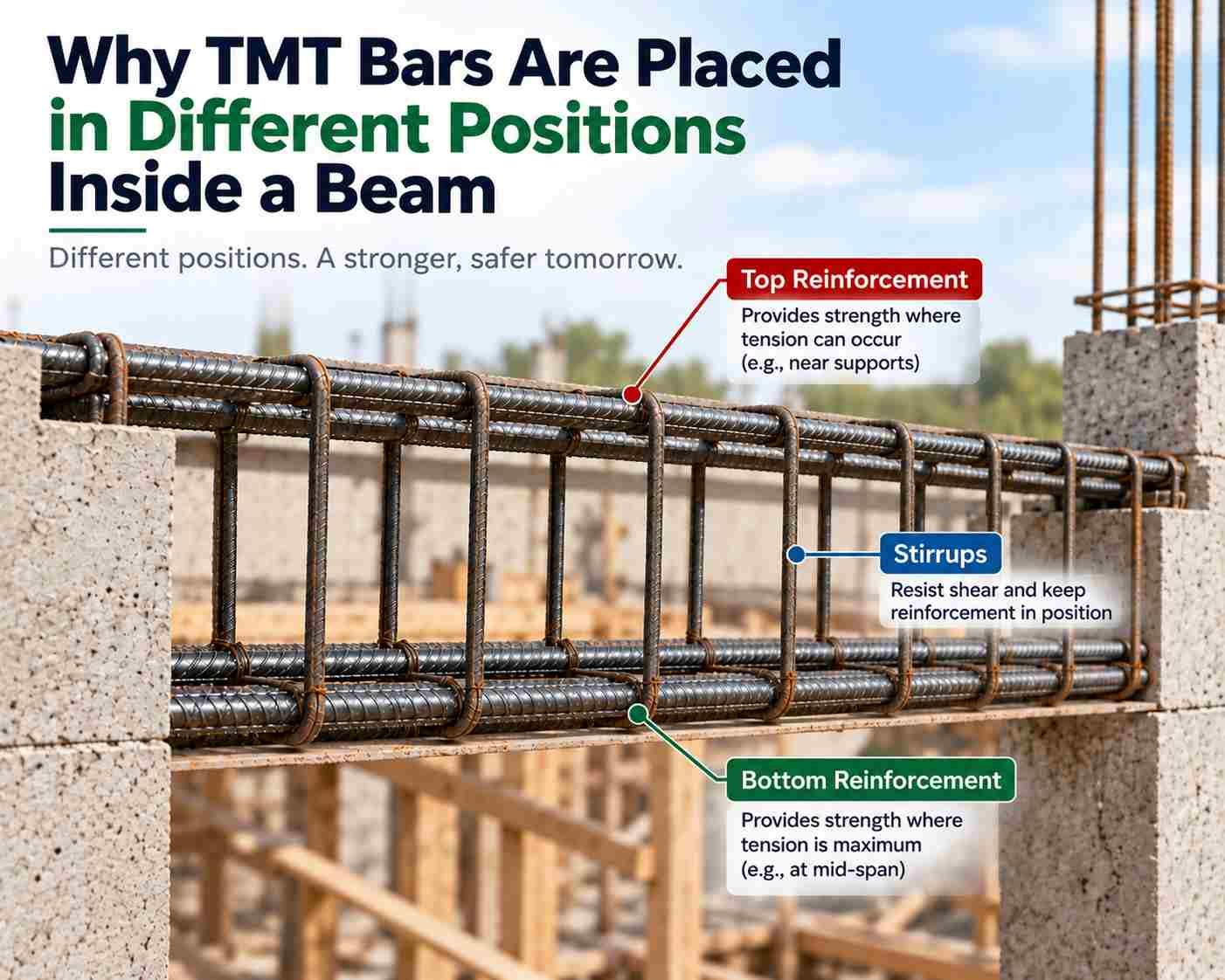
Beams are horizontal members that transfer floor and roof loads to columns. They experience both tension at the bottom face and compression at the top — making high tensile strength and ductility critical. Beams also carry stirrups, small U-shaped bars at regular intervals which resist shear forces and prevent diagonal cracking.
Steel percentage in beams: Typically 1% to 2% of the beam’s cross-sectional area
Why it matters for Kerala: Beams in Kerala homes must handle live loads from heavy monsoon water on terraces, overhead water tanks, and solar panel installations, all adding to the structural demand.
Slabs are the horizontal floor and roof panels. TMT bars in slabs run in two perpendicular directions to distribute loads evenly across the concrete. Inadequate TMT quality in slabs shows up as hairline cracks in the floor, often dismissed as cosmetic. In reality, it signals the bar is underperforming under load.
Bar sizes: 8mm to 12mm. Steel ratio: approximately 0.12% to 0.15% of slab cross-sectional area
Retaining walls hold back soil, particularly critical in Kerala’s hilly districts like Wayanad, Idukki, and Malappuram where soil pressure after heavy rain is significant. Staircases require TMT bars in both the waist slab and individual steps to carry dynamic human loads and prevent cracking under repeated stress.
Also Read: Best TMT Steel in Kerala for Home Construction: Why Fe 550 SD is the Right Choice
The word quality is used freely by every TMT brand. Here is what it means in technical terms you can verify.
The load at which a bar begins to permanently deform. Measured in N/mm². A Fe 550 SD bar has a minimum yield strength of 550 N/mm², this is what the 550 in the grade name refers to. Higher yield strength means the bar can carry more load before bending.
The maximum load a bar can carry before fracturing. For Fe 550 SD, minimum UTS is 600 N/mm². The ratio of UTS to yield strength must be ≥ 1.10 as per IS 1786, this ensures the bar visibly deforms before it fails, rather than snapping without warning.
How much a bar can stretch before fracturing, expressed as a percentage. Fe 550 SD has a minimum elongation of 16%. Higher elongation means the bar absorbs seismic energy and deforms under earthquake forces without fracturing. This is exactly why the SD (Special Ductility) designation exists and why it matters in Kerala’s seismic zones.
IS 1786:2008 limits carbon content of TMT bars to a maximum of 0.25%. Higher carbon increases hardness but reduces weldability and ductility. Excess sulfur and phosphorus make the bar brittle. Quality manufacturers control these elements at the billet stage, which is why virgin steel billets matter.
The mandatory Indian standard for high strength deformed steel bars. The ISI mark stamped on a bar confirms the manufacturer’s product and process have been audited and certified by the Bureau of Indian Standards. Always check for the ISI mark physically on the bar, not just on packaging.
Kenza TMT barscarry full BIS certification under IS 1786:2008 across all grades Fe 500, Fe 500D, Fe 550, Fe 550D, Fe 550 SD, and Fe 600.
| Grade | Yield Strength | Best For | Kerala Suitability |
| Fe 500 | 500 N/mm² | Basic G+1 homes | Low-risk zones only |
| Fe 500D | 500 N/mm² | Most residential homes | Seismic zones — recommended |
| Fe 550 SD | 550 N/mm² | Multi-storey, coastal | Kerala standard — preferred |
| Fe 600 | 600 N/mm² | High-rise, industrial | Heavy commercial structures |
Kerala is not a standard construction environment. Its combination of natural factors creates demands on TMT bars that do not exist in most other Indian states.
Kerala sits across Seismic Zones II and III. Districts like Idukki, Wayanad, Palakkad, parts of Kozhikode, and northern Kerala fall in the more active zones. The 2018 Kerala floods were accompanied by landslides triggered partly by seismic activity. Structures in these zones must use bars with high ductility — Fe 500D minimum, Fe 550 SD strongly recommended.
Kerala has a 590 km coastline. Salt-laden air, high chloride content in the atmosphere, and permanent moisture create aggressive corrosion conditions for steel. In districts like Kozhikode, Thrissur, Ernakulam, and Kollam, standard TMT bars corrode faster, reducing the bar’s effective cross-section over time and causing the concrete to crack.
CRS (Corrosion Resistant Steel) certification — which Kenza TMT Fe 550 SD carries, is not a premium extra in Kerala. It is a basic necessity for coastal and near-coastal construction.
Kerala receives over 3,000 mm of annual rainfall. Foundations in low-lying areas of Alappuzha, Kottayam, Thrissur, and coastal Kozhikode regularly face waterlogged conditions. Submerged steel corrodes faster. TMT bars in these foundations must have low carbon content, high elongation, and CRS certification to survive long-term exposure.
TMT bars retain their mechanical properties at elevated temperatures better than cold-twisted deformed (CTD) bars. The tempered martensite structure is thermally stable up to approximately 300–400°C, giving structures additional fire resistance without any modification to the bar itself.
Kenza TMT has been manufacturing TMT bars in Kerala since 1990 — over 33 years.
Fe 550 SD is Kenza’s flagship grade, not by accident. It is the grade that most directly addresses Kerala’s combined seismic, coastal, and monsoon demands:
Kenza TMT’s network of hundreds of authorised distributors across Kerala ensures the product reaching your site is the same product that left the factory — no grey market, no misrepresentation.
You see the finish. You see the tiles, the paint, the fittings. What you do not see is the steel skeleton inside every column, beam, and slab — working every day to keep your home standing.
A quality TMT bar:
Choosing the right TMT bar is not a decision reserved for structural engineers. It is the most fundamental quality decision every home builder, contractor, and developer makes. In Kerala, with its monsoons, its coastline, its seismic zones, and its building ambitions, that decision carries real weight. Kenza TMT Fe 550 SD is built for exactly this. Talk to our team today and get started on your project the right way. Contact Kenza TMT now.