When choosing reinforcement steel for a construction project, one of the most common questions is whether TMT bars or epoxy-coated steel last longer. The answer isn’t as straightforward as choosing one material over the other. Both are designed to improve the durability of reinforced concrete, but they achieve this in different ways and perform best under different conditions.
After analysing modern construction practices, corrosion behaviour, Indian building requirements, and the applications recommended by manufacturers and engineers, one conclusion becomes clear: there is no universal winner. The right choice depends on where the structure is being built, how it will be exposed to moisture or chemicals, and how long you expect it to perform with minimal maintenance.
In this guide, we’ll compare TMT bars and epoxy-coated steel based on:
By the end, you’ll have a clear understanding of which reinforcement option is best suited for your construction project.
Thermo-Mechanically Treated (TMT) bars are high-strength reinforcement bars manufactured using a controlled heating and rapid cooling process. This process creates a tough outer layer while maintaining a ductile core, making the bars both strong and flexible.
Modern CRS (Corrosion Resistant Steel) TMT bars further improve durability by incorporating alloying elements that enhance corrosion resistance throughout the steel itself instead of relying on an external protective layer.
Today, CRS TMT bars are widely used in:
Their popularity comes from their excellent combination of strength, ductility, earthquake resistance, and corrosion resistance.
Epoxy-coated steel, commonly known as epoxy-coated rebar, is conventional reinforcing steel covered with a thin protective epoxy coating.
The coating acts as a physical barrier that prevents moisture, oxygen, and chlorides from reaching the steel surface. Because corrosion begins only when these elements come into contact with steel, the coating helps delay rust formation.
Epoxy-coated reinforcement is commonly specified for:
Its performance depends heavily on maintaining an intact coating throughout transportation, storage, fabrication, and installation.
Many people assume that concrete completely protects reinforcement steel forever. In reality, concrete becomes vulnerable over time.
Moisture, oxygen, chlorides from seawater, industrial pollutants, and carbonation gradually penetrate the concrete. Once these reach the reinforcement, corrosion can begin.
As steel rusts, it expands.
This expansion creates internal pressure that leads to:
This is why corrosion resistance has become one of the most important considerations when selecting reinforcement.
One misconception is that corrosion resistance only comes from coatings.
Modern CRS TMT bars resist corrosion because of their metallurgical composition.
Instead of depending solely on an outer protective layer, specially controlled alloying elements improve resistance throughout the steel itself.
This provides several advantages:
For most residential and commercial construction, this built-in corrosion resistance provides excellent long-term performance.
Epoxy-coated reinforcement works differently. Rather than changing the steel itself, manufacturers apply a protective coating around the reinforcement.
When the coating remains intact, it creates an effective barrier against corrosive elements. However, construction sites are rarely perfect. During transportation, unloading, bending, tying, or concrete placement, coatings can become scratched or chipped if not handled carefully. Even small damaged areas may become vulnerable to localized corrosion if left unrepaired.
This doesn’t mean epoxy-coated steel is ineffective. It simply means that installation quality becomes a critical factor in achieving its intended service life.
The honest answer is:
It depends on where the reinforcement is being used.
For most buildings, including houses, apartments, schools, offices, and commercial structures, high-quality CRS TMT bars provide outstanding durability with fewer installation concerns.
For highly aggressive environments where structures face constant chloride exposure, such as bridges near the sea, marine structures, ports, or certain industrial facilities, engineers may specify epoxy-coated reinforcement as part of the overall durability strategy.
Rather than asking which material lasts longer in every situation, the better question is: Which material is better suited to the environment where the structure will operate? That is the question professional engineers ask before selecting reinforcement.
When evaluating long-term durability, several practical factors matter.
Corrosion Resistance
Construction Handling
Maintenance
Cost
This is one of the most frequently asked questions.
Many people assume that every coastal building automatically requires epoxy-coated reinforcement. In reality, the decision depends on multiple engineering factors, including:
For many residential buildings in coastal regions, high-quality CRS TMT bars combined with proper concrete mix design and good construction practices provide excellent durability.
For marine structures experiencing direct saltwater exposure, engineers may choose epoxy-coated reinforcement or other specialized corrosion-resistant reinforcement systems depending on the project’s design requirements.
If you’re building a home, durability, safety, cost, and ease of construction all matter. For most houses, CRS TMT bars offer an excellent balance because they provide:
Unless a structural engineer specifies otherwise due to exceptional environmental conditions, CRS TMT bars are often the preferred reinforcement for residential construction.
One trend we’ve observed across the construction industry is that many buyers focus only on the word “coated” and assume it automatically means better protection.
In reality, durability is influenced by far more than surface protection.
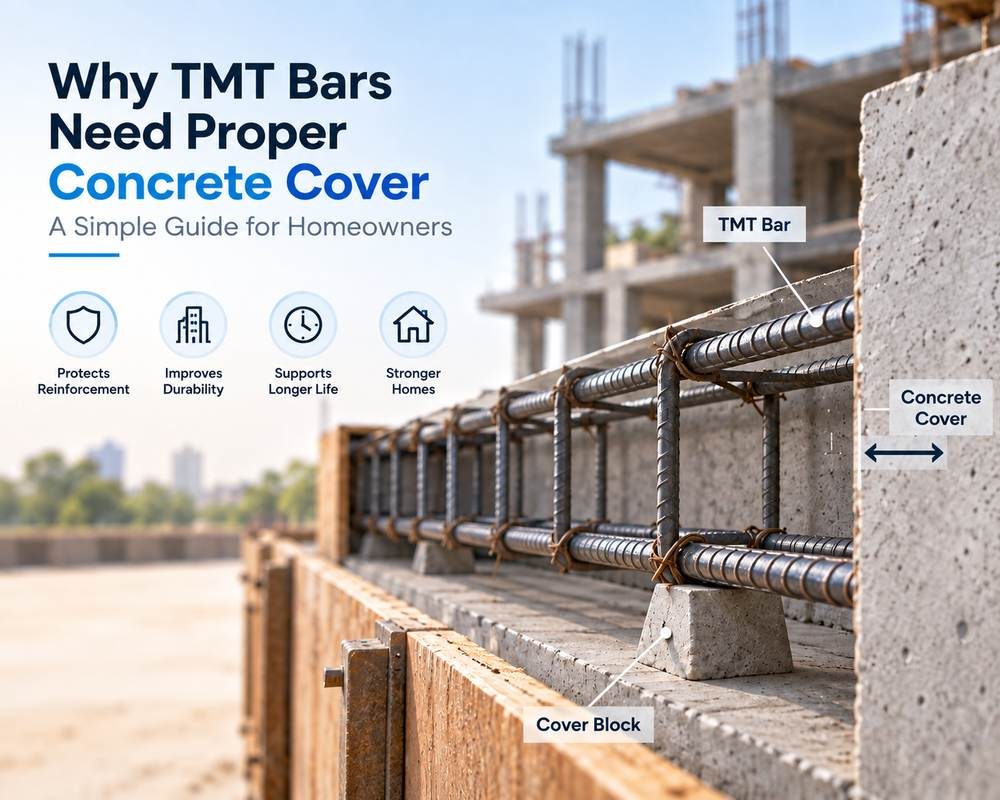
Concrete quality, structural detailing, proper cover, workmanship, drainage, environmental exposure, and the quality of reinforcement all work together to determine how long a structure lasts.
The best reinforcement cannot compensate for poor construction practices, just as excellent construction cannot fully compensate for inferior materials.
That is why selecting certified, high-quality reinforcement and following sound engineering practices remains the smartest long-term investment.
If your project involves a typical residential, commercial, or institutional building, high-quality CRS TMT bars are generally the more practical and cost-effective choice, offering strength, corrosion resistance, and ease of construction.
If your project is located in an extremely aggressive environment with continuous chloride exposure, epoxy-coated steel may be appropriate when specified by the structural engineer and installed with proper handling procedures.
The best reinforcement is not the one with the most marketing claims, it is the one selected for the actual service conditions of the structure.
Making that decision with the guidance of experienced engineers and choosing certified reinforcement materials will always deliver better long-term durability than relying on assumptions alone.