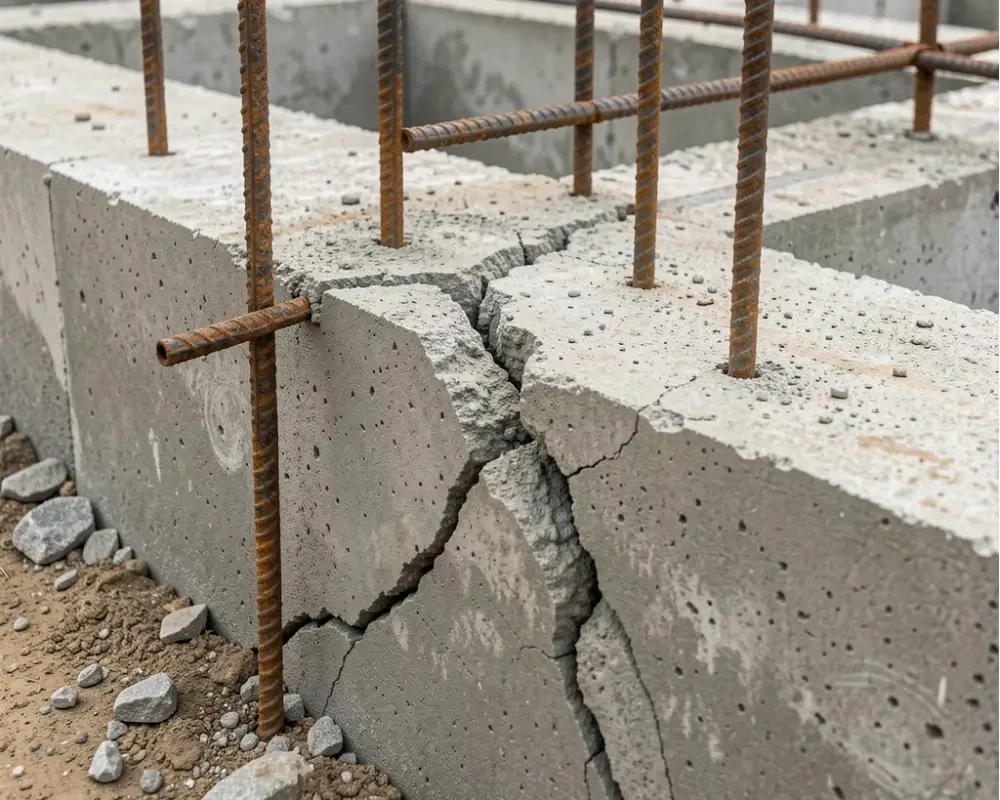
Before comparing them, let us quickly understand what each of these bars actually is.
TMT bars are made using a special heat and water treatment process. After hot rolling, the steel is passed through a water-cooling system. This gives the bar a hard outer surface and a soft, flexible inner core. That unique structure is what makes TMT bars so strong and earthquake-resistant.
HYSD is the short form of High Yield Strength Deformed Steel Bars. These bars are produced by heating steel and then shaping it through hot rolling or cold twisting processes. The surface of HYSD bars contains ribs or lugs, which improve the bond between the steel and concrete, helping the structure hold firmly. Before the introduction and widespread use of TMT bars, HYSD bars were commonly used in construction across India and many other parts of the world.
The manufacturing process is the single biggest reason why these two bars behave so differently on a construction site.
Step 1 — Hot Rolling: Steel billets are heated and passed through a rolling mill at high temperature to form the bar shape.
Step 2 — Water Quenching: The hot bar is instantly passed through a water-cooling system. This rapidly cools the outer surface, making it very hard.
Step 3 — Self-Tempering: The hot inner core warms the outer layer slightly, creating a tempered martensitic surface — hard outside, soft inside.
Step 4 — Atmospheric Cooling: The bar cools at room temperature, allowing the soft inner core (ferrite-pearlite structure) to form giving it ductility and flexibility.
HYSD bars are heated and then either hot rolled or cold twisted to achieve their shape and strength. The cold twisting process physically deforms the steel. While this gives the bar its deformed surface which improves concrete bonding it also introduces residual stress inside the bar. That residual stress can become a weakness over time, especially when the bar is exposed to extreme loads, vibrations, or earthquakes.
Here is a clear side-by-side comparison of the most important differences
| Feature | TMT Bars | HYSD Bars |
| Full Form | Thermo Mechanically Treated | High Yield Strength Deformed |
| Manufacturing | Water quenching & tempering | Hot rolling or cold twisting |
| Tensile Strength | Higher — less residual stress | Good, but lower than TMT |
| Ductility | Excellent — bends without cracking | Lower — may crack under bending |
| Corrosion Resistance | Very High | Moderate — needs extra treatment |
| Earthquake Resistance | Excellent — absorbs seismic shocks | Poor — not ideal in seismic zones |
| Weldability | Easy and reliable | Possible but more difficult |
| Surface Defects | None — clean outer surface | Possible from cold twisting |
| Steel Consumption | 8–11% less steel needed | Higher quantity required |
| Cost Efficiency | Better value long-term | Lower upfront, higher maintenance |
| Best For | All modern construction | Small, low-stress structures only |
When builders talk about strength, they usually mean two things yield strength (how much load a bar can carry before it starts to deform) and tensile strength (how much load it can handle before it breaks).
TMT bars have an advantage in both areas. Because the manufacturing process involves no physical deformation, there is no residual torsional stress inside the bar. A HYSD bar that has been cold twisted carries that twist-related stress permanently. Over time especially under heavy loads or during an earthquake that internal stress can lead to failure.
Bottom Line on Strength
For heavy-duty construction — high-rise buildings, bridges, dams, flyovers — TMT bars are clearly the stronger and safer choice. For small, low-load structures, HYSD bars may still work, but they are no longer the preferred option even there.
Rust is one of the biggest threats to any steel reinforcement. When steel inside concrete rusts, it expands, cracks the concrete, and weakens the entire structure. This is a slow but serious problem in places with high humidity, coastal environments, or regular rain.
Here is where TMT bars pull well ahead of HYSD bars. The water quenching and tempering process in TMT manufacturing gives the bar a controlled chemical composition with balanced levels of carbon, sulphur, and phosphorus. This makes the bar naturally resistant to rust and corrosion.
HYSD bars, on the other hand, have a higher carbon intake and can corrode faster, especially in humid or coastal regions. They may need additional surface treatments or coatings to be used safely in such environments.
TMT bars come in several grades based on their yield strength. The number after ‘Fe’ tells you the minimum yield strength in megapascals (MPa). Higher number = stronger bar.
| Grade | Best Used For | Strength Level |
| Fe 415 | Small homes & light structures | Lowest |
| Fe 500 | Most popular — homes & offices | Standard |
| Fe 500D | Ductile variant — earthquake zones | Standard+ |
| Fe 550 | Industrial & infrastructure projects | High |
| Fe 600 | High-rise & heavy-load buildings | Highest |
For most residential construction in India, Fe 500 and Fe 500D (the ‘D’ stands for ductile) are the most widely recommended grades. They give you the right balance of strength, flexibility, and cost.
Buyer Tip
Always check that the TMT bars you purchase carry the IS 1786:2008 certification from the Bureau of Indian Standards (BIS). This is the quality benchmark. Do not buy bars without it.
The right bar depends on what you are building, where you are building it, and what conditions the structure will face over its lifetime.
Expert Recommendation (2026)
Most structural engineers today specify TMT bars as the default choice for both large and small projects. The cost difference between TMT and HYSD bars has narrowed significantly, while the safety and durability benefits of TMT remain well ahead.
This is a question almost every homebuilder asks. On the surface, HYSD bars can appear slightly cheaper per kilogram at purchase. But the real cost comparison goes deeper than that.
Because TMT bars have higher load-bearing capacity, you need 8 to 11% less steel to achieve the same structural strength. That difference in quantity directly reduces your total material cost. Add to that the fact that TMT bars have longer service life and require less maintenance — and the overall cost over the life of a building often favours TMT bars significantly.
Think of it this way — spending slightly more on the right steel during construction is far cheaper than repairing structural damage 10 or 15 years later.
The main difference is in how they are made. TMT bars use a water quenching and tempering process that gives them a hard outer surface and a soft, ductile core with no physical twisting. HYSD bars are made by cold twisting or hot rolling the steel, which introduces residual stress inside the bar and reduces long-term performance.
HYSD bars are still available and occasionally used in smaller or low-load projects. However, TMT bars have largely replaced them in modern construction because of their superior strength, flexibility, corrosion resistance, and compliance with updated IS codes.
TMT bars specifically Fe 500 or Fe 500D grade are the standard recommendation for house construction across India. They are BIS certified, earthquake-resistant, and proven to perform well in India’s varied climate conditions, from coastal humidity to dry inland regions.
The price per kilogram may be similar or slightly higher for TMT bars. However, because TMT bars offer higher strength, you need less steel for the same job making the overall project cost with TMT bars comparable to, or even lower than, using HYSD bars.
TMT bars are strongly recommended for construction in seismic or earthquake-prone zones. Their soft ductile inner core allows the bar to absorb seismic energy and bend under shock without snapping which is critical for keeping a building standing during an earthquake.
HYSD stands for High Yield Strength Deformed. The ‘deformed’ part refers to the ribs or lugs on the bar’s surface that improve its bonding with concrete. These deformations are created during the cold twisting or hot rolling process.
If you have read this far, the answer is probably already clear: TMT bars win in almost every category that matters for construction in 2026.
They are stronger, more flexible, more corrosion-resistant, easier to weld, and safer in earthquakes. They require less steel per project, which can actually make them more cost-effective than HYSD bars when you look at the full picture.
HYSD bars had their time, and they were a significant improvement over plain mild steel bars. But the construction industry has moved forward. For any serious building project today whether it is a family home, a commercial building, or heavy infrastructure TMT bars are the clear, safe, and smart choice.
When buying TMT bars, always look for BIS-certified products and choose the right grade (Fe 500 or Fe 500D for most residential work). Purchase from a reputed manufacturer. Your building’s safety over the next 50 years starts with the steel you choose today.